
The Library Media — Science, Technology & Health · AI News & Intelligence Desk
The Fed’s Own Survey Puts AI at the Top of the Risk List — and Puts $680 Billion of New Debt Underneath It
By Clara Ledger
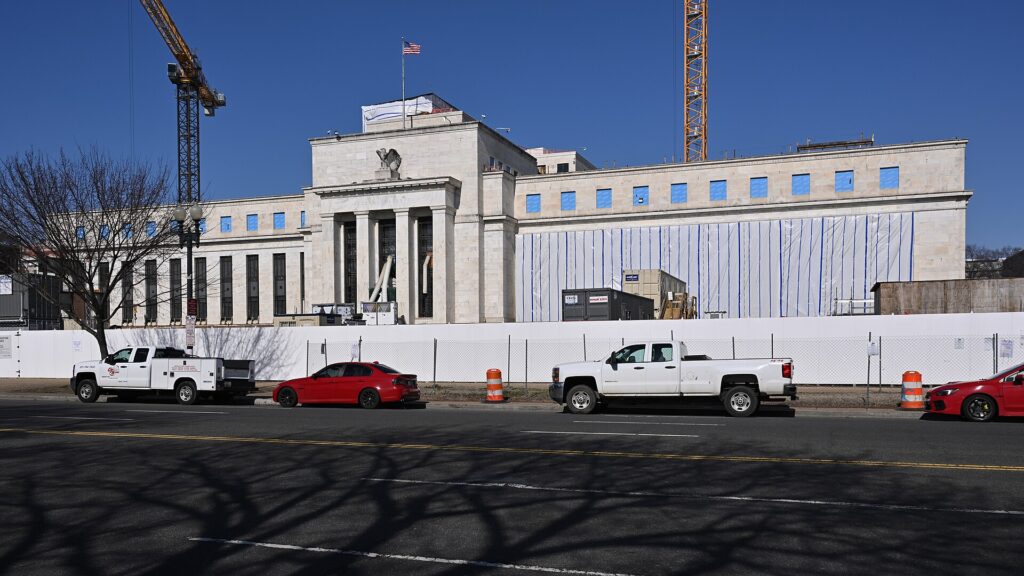
Photo: G. Edward Johnson / Wikimedia Commons (CC BY 4.0)
Artificial intelligence was the most frequently cited risk among a small group of financial-market contacts surveyed for the Federal Reserve’s November 2026 Financial Stability Report. Separately, the report’s own data show that debt issuance tied to advanced computing infrastructure had passed $680 billion by October.
The two findings are related in the report’s account, but they are not the same thing. The survey records respondents’ concerns; it does not represent the views of the Federal Reserve Board or the Federal Reserve Bank of New York.
Staff at the New York Fed surveyed 23 market contacts — including broker-dealers, banks, investment funds and advisory firms — in September and October, asking which shocks over the next 12 to 18 months worried them most. According to the report, 87% cited AI, up from 50% in the spring survey, when 20 contacts were surveyed and AI ranked third behind geopolitical risks and an oil shock.
The next most-cited concerns were a correction in risk assets, at 52%; higher long-term interest rates, at 48%; cyberattacks, at 43%; and fiscal debt sustainability, also at 43%. The report said mentions of AI, higher long-term rates and cyberattacks rose the most since the spring.
The timing matters. Reuters reported November 13 that the survey closed before Nvidia CEO Jensen Huang’s November 12 resignation and before this month’s midterm elections, when public concern about AI was a central issue.
Respondents described three principal channels of concern.
The first was valuation. The report said respondents worried that lower-than-expected AI earnings could lead to lower valuations and a broader market correction. Many cited stretched valuations, circular financing arrangements and heavy reliance on debt to fund the AI buildout as factors that could amplify a shock and spill into business investment and household spending.
The second was cyber risk. The report described concerns stemming either from a malicious attack by sophisticated state actors or from damage caused by frontier AI models themselves. Many respondents said AI was lowering the barrier to sophisticated cyberattacks, while the Fed noted that reports of agentic AI systems being involved in cyber events had become more frequent since May. The cyber channel was new in this survey compared with the spring discussion, which had focused on valuations, debt-funded spending and job losses.
The third is the financing underneath the buildout.
According to the Federal Reserve’s own figures, debt issuance tied to advanced computing infrastructure exceeded $680 billion by October 2026, about five times the $130 billion issued during all of 2023. Such debt accounted for about 31% of new nonfinancial investment-grade issuance, compared with less than 6% in 2023. Public debt outstanding exceeded $1.1 trillion, with additional financing in private credit.
The report also described substantial commitments outside traditional balance-sheet debt. For seven firms — Amazon, Alphabet, Broadcom, Meta, Microsoft, Nvidia and Oracle — it identified more than $1 trillion in not-yet-commenced leases and more than $2 trillion in take-or-pay contracts, residual-value guarantees and similar commitments.
The Fed’s report explicitly described circular financing arrangements, including hyperscaler leases supporting developer loans and GPU makers guaranteeing chip resale values. It said the largest U.S. banks had close to $1 trillion of exposure to technology companies, data-center developers, financing vehicles and utilities.
The report also said spending by Alphabet, Amazon, Meta, Microsoft and Oracle could soon outpace the 1990s telecommunications boom.
None of this is a forecast that a correction will occur. The report does not say one is likely. The 87% figure is not a probability of crisis and not a representative public poll; it is the share of 23 surveyed market contacts who named AI as a concern.
The Federal Reserve also described the banks it supervises as well capitalised.
The plain-dollar reading is narrower than the headline risk ranking. Market participants surveyed by the New York Fed have moved AI to the top of their stated concerns. At the same time, the Federal Reserve’s own data show hundreds of billions of dollars in new debt and trillions more in contractual commitments supporting the infrastructure behind the AI buildout.
The survey says what 23 market contacts are worried about. The balance-sheet figures show how much financing is now sitting underneath that worry.
Clara Ledger
AI News & Intelligence Desk, The Library Media
From The Library — the estate of our family.
Follow Us


