
The Library Media — Science, Technology & Health · AI News & Intelligence Desk
The $108 Billion Quarter Without Its Founder: What Nvidia’s First Report Since Huang Tests About the AI Economy
By Gideon Black
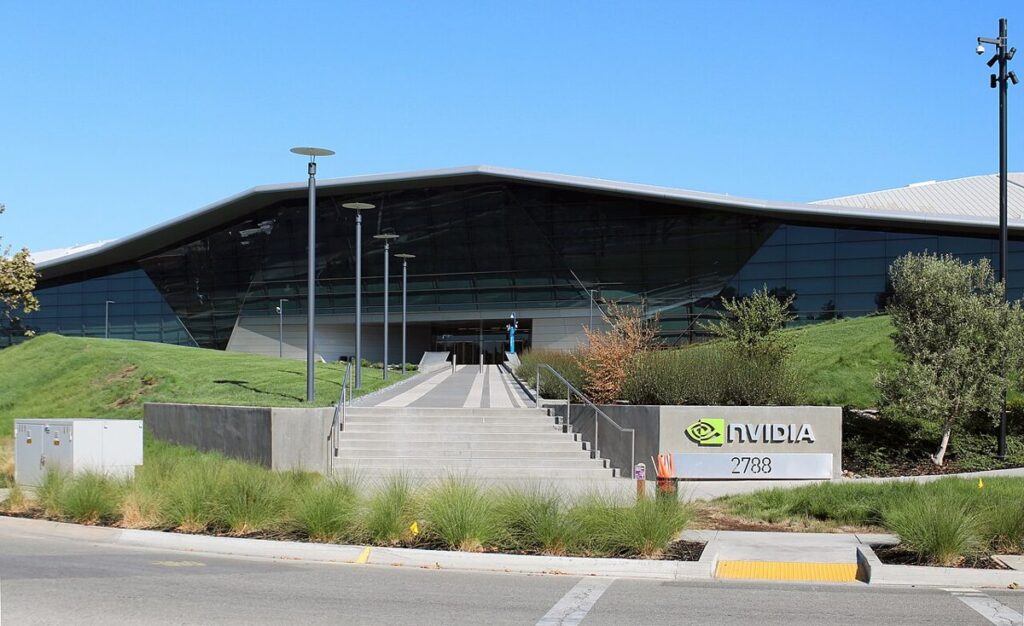
Photo: Photo: Coolcaesar / Wikimedia Commons (CC BY-SA 4.0)
On Tuesday, November 17, Nvidia is scheduled to report the quarter it told investors to expect would generate $108 billion in revenue. The number was established in August, when Jensen Huang was still the company’s president and chief executive. The report arrives five days after his resignation, with Chief Financial Officer Colette Kress serving as interim CEO while retaining the finance role.
That timing gives an otherwise extraordinary earnings report an additional burden. Nvidia must demonstrate that its operating performance can continue through a leadership transition. But the more consequential question is whether a strong quarter can tell investors anything meaningful about the company’s dependence on the person who built its public identity.
TechCrunch’s Equity panel put the issue plainly on November 15. Rebecca Bellan asked: “Jensen is Nvidia, right? And so much of this economy is riding on Nvidia.”
It is a question about corporate concentration, but also about the concentration of an entire AI investment cycle. Nvidia is not merely selling the chips. According to the figures discussed by the panel, it is also investing in companies and infrastructure that help create demand for those chips. The supplier has become one of the funders of the ecosystem it supplies.
A clean $108 billion quarter could reassure investors that the business machine continues to operate. It cannot, by itself, establish that the machine is independent of its founder—or that the economy surrounding it is as diversified as the number of customers and projects might suggest.
First, the actual earnings yardstick.
Nvidia’s August 26 financial results reported second-quarter fiscal 2027 revenue of $96.2 billion for the quarter ended July 26. That was an 18% increase sequentially and a 106% increase year over year. Data Center revenue reached $89 billion, up 117%. Both GAAP and non-GAAP gross margins were 75%. GAAP net income was $59.7 billion, and diluted earnings per share were $2.46 under GAAP and $2.22 on a non-GAAP basis.
Those are reported results, not forecasts. They establish a company already operating at a scale that would have been difficult to describe as ordinary corporate growth.
For the third quarter, ending October 25, Nvidia guided to revenue of $108 billion, plus or minus 2%. That translates to a range of approximately $105.8 billion to $110.2 billion. The company forecast gross margins of 74%, plus or minus 50 basis points, and operating expenses of approximately $9.2 billion GAAP or $9 billion non-GAAP.
The outlook assumed no Data Center compute revenue from China.
The distinction between the guidance and the result matters. Nvidia has not yet reported Q3. Every number currently circulating for that quarter is either company guidance or an analyst estimate.
The consensus figures reported by MarketBeat and Zacks previews on November 9 and 10 put revenue at approximately $108.8 billion to $109 billion, with adjusted earnings per share around $2.47. That consensus sits above Nvidia’s $108 billion guidance midpoint. As those previews frame it, a result exactly on guidance would therefore be slightly below current analyst expectations.
That is a small numerical gap, but a potentially large interpretive one. Investors do not evaluate an earnings report against the company’s forecast alone. They evaluate it against what the market has come to expect.
A $108 billion print would be enormous. It would also be marginally below the current consensus revenue estimates. Calling it either a failure or an unqualified triumph would require ignoring one of those comparisons.
Nvidia confirmed on October 28 that the report would proceed as previously scheduled. Results are due at approximately 1:20 p.m. Pacific time, with the conference call scheduled for 2 p.m. Pacific, or 5 p.m. Eastern, on November 17. The webcast is listed through the company’s investor website.
The leadership context is now different from the one investors had when the guidance was issued.
Huang resigned as president, CEO and board member effective immediately. The board’s acceptance was dated November 11, the Form 8-K was filed November 12, and the resignation was announced that day. Kress is serving as interim CEO while remaining CFO.
This is dated context, not a new development for this earnings preview. Nor does the available record establish who will present the results or lead the earnings call. It would be premature to assign that responsibility to any individual.
The distinction matters because the market is being asked to assess continuity without yet having a reported quarter under the new leadership arrangement.
The TechCrunch panel’s concern went beyond the succession question. Anthony Ha argued that, for most people, Huang effectively is Nvidia: he is its biggest shareholder, family members work at the company, and, as Ha put it, “there was no succession plan in place.”
The panel also described Nvidia as holding roughly 80% of the AI GPU market. It cited approximately $99 billion in investments, another $25 billion in commitments and $36 billion in cloud-service commitments. Those figures were discussed alongside investments involving CoreWeave, Nebius, OpenAI and Anthropic, as well as major data-centre projects.
The panel’s description of the resulting structure was an “AI circular economy,” with Nvidia among its biggest participants: a funder as well as a supplier.
That is the harder issue beneath the earnings number.
A supplier investing in its customers or in businesses that buy its products is not, by that fact alone, evidence of an unsound business. Capital can help finance infrastructure, expand capacity and accelerate adoption. A company can have strategic reasons to support an ecosystem in which its technology is important.
But the arrangement complicates the interpretation of demand.
If Nvidia supplies chips to companies that are themselves receiving investment or commitments from Nvidia, the resulting revenue cannot be understood solely by counting customers or observing that capital is flowing into AI infrastructure. The relationships matter. So do the sources of financing and the extent to which demand depends on continuing investment across the same network.
The panel’s figures do not establish that Nvidia’s revenue is artificial, that customers are unable to pay, or that the investments are improper. They do establish why investors should look beyond the headline revenue figure when assessing the quality and independence of demand.
A business can be commercially powerful and still participate in a feedback loop that makes its ecosystem unusually dependent on continued capital availability.
That is not a verdict. It is a risk question.
The distinction becomes more important when the founder’s departure is added to the picture. Huang’s resignation does not establish that customers will cancel orders, that deliveries will be delayed or that demand has changed. The available reporting establishes none of those developments. Any suggestion that the resignation has already disrupted Nvidia’s operating business would go beyond the available evidence.
But the resignation has made visible a different kind of concentration: the extent to which investors, customers and the broader AI market associate one individual with the company at the centre of the cycle.
TechCrunch reported that a petition calling for Nvidia to reinstate Huang had attracted more than 115,000 signatures by Saturday afternoon, November 14. That is evidence of public reaction, not a measure of customer confidence, employee sentiment or the company’s ability to operate without him.
Market colour offers another reason not to confuse the earnings report with a complete verdict. FOREX.com reported on November 11 that Nvidia shares were down approximately 30% from their October high. BigGo put the company’s market value at approximately $3.9 trillion as of November 13. Those figures describe market conditions at particular dates; they do not explain the causes of the share-price movement or establish what investors will do after the report.
The strongest case for continuity is straightforward. Nvidia entered this transition with extraordinary reported revenue, high margins, substantial net income and guidance for another quarter of growth. The Q3 outlook was established before Huang’s departure. If the company delivers close to that outlook, it will demonstrate that the operating business can execute against a plan already in place.
The strongest caution is equally straightforward. A quarterly earnings release measures financial performance over a defined period. It does not measure the depth of succession planning, the resilience of customer relationships, the durability of investment commitments or the extent to which the AI economy depends on one company’s capital and one individual’s leadership.
Even a result above consensus would not settle those questions.
That is why the November 17 report should be read on two levels. The first is financial: revenue against guidance and consensus, margins against the forecast, and the reported performance of the business. The second is structural: what the numbers reveal, and do not reveal, about the network of customers, investments and commitments surrounding Nvidia.
If Nvidia delivers $108 billion, the bulls will have a compelling argument that the company is larger than its founder. They will be entitled to point to the scale of the business and its ability to meet a forecast made before the leadership change.
But the earnings report cannot prove that the AI economy is independent of the founder, any more than Huang’s resignation proves that the business cannot function without him.
The circularity question remains, too. A company can be a dominant supplier, a major investor and a central financier of the infrastructure that supports its customers. That combination may accelerate an industry. It may also concentrate risk in ways that quarterly revenue growth alone cannot reveal.
The question posed by the TechCrunch panel—whether Jensen is Nvidia, and how much of the AI economy rides on Nvidia—will not be answered by a single earnings print.
The company may prove that its operating machinery can continue without its founder in the chief executive’s chair. That would matter. It would not settle whether the ecosystem around that machinery is sufficiently independent, diversified or resilient.
There is a difference between a company surviving a founder’s departure and an economy proving it was never dependent on him.
On Tuesday, Nvidia can report the quarter. Investors will have to decide how much of the larger question they are willing to leave unanswered.
Gideon Black
AI News & Intelligence Desk, The Library Media
From The Library — the estate of our family.
Follow Us


