
The Library Media — Sports · NASCAR
NASCAR Raises Cup Horsepower to 750 at Intermediate Tracks From the 2027 Coca-Cola 600, With an 800-Horsepower Test at the All-Star Race
By Megan McCarthy
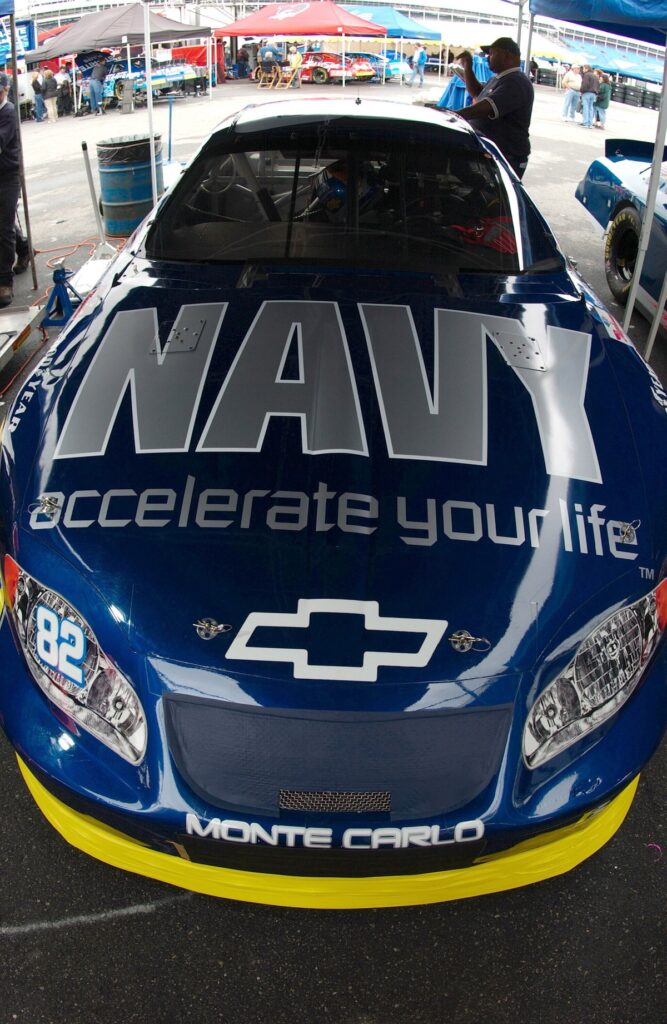
Photo: U.S. Navy Photo by Chief Photographer’s Mate Chris Desmond. / Wikimedia Commons (Public domain)
NASCAR will increase engine horsepower in the Cup Series at intermediate tracks from 670 to 750 beginning with the 2027 Coca-Cola 600, while an 800-horsepower engine will be tested the following week at the All-Star Race at North Wilkesboro. The changes are part of a rules update released Friday, November 20, 2026, according to Motorsport.com, which reported on NASCAR’s rules bulletin.
The All-Star Race test will take place during a non-points exhibition. It is not confirmation that an 800-horsepower package will become the standard for the 2027 season.
NASCAR’s longer-term plans remain conditional on the outcome. If the All-Star trial proves successful, the 800-horsepower engine will be introduced at all short tracks in 2028, with an expectation that it would subsequently extend to intermediate tracks. The rules update does not establish horsepower figures for 2027 short-track, road-course or superspeedway races. Despite broader coverage describing the changes as applying across all tracks, the bulletin does not set a universal 2027 horsepower package.
The remainder of the 2027 package includes several changes to vehicle configuration and competition procedures. Splitter stuffers will be removed at all short tracks and road courses. NASCAR will also remove minimum damper-length requirements, giving teams greater freedom in suspension setup.
Owner standings will determine the starting field for all races except the Daytona 500, the Clash and the All-Star Race. Crew chiefs will have authority to decide whether to use wet-weather tires on ovals.
The rules update also clarifies track limits at Talladega. A car will be considered out of bounds when its left-side tires go beneath the left line of the inside double painted lines. Engine-seal requirements will change as well: full-time teams must compete in at least 20 points races with a sealed engine. The L3 penalty will also be added to the O’Reilly Auto Parts Series and the FedEx Freight Truck Series.
NASCAR has also revised the points consequences for drivers or owners who miss a race because of a suspension. An affected competitor begins the Chase at 2,000 points. The corresponding figures are 2,020 points in the O’Reilly Auto Parts Series and 2,030 in the FedEx Freight Truck Series.
There is an exception when NASCAR grants approval. In that circumstance, points remain unchanged. The suspension of Carson Hocevar by Spire Motorsports at Homestead was cited as an example of the situation addressed by the provision.
NASCAR COO Steve O’Donnell discussed the direction of the rules changes at the organization’s state-of-the-sport press conference. He said competitors and fans had communicated that they wanted more horsepower across the board for the Next Gen car. NASCAR wants to “continue to improve the product” while being “very cautious” about making a larger increase. O’Donnell described the current racing as “pretty good” and said the facts compared with other sports were “pretty strong.”
O’Donnell also ruled out developing a Gen-8 car, saying NASCAR would continue improving the Next Gen platform. A new car would be expensive and disruptive, he said. Instead, NASCAR will examine the best way to increase horsepower, whether through existing engines or new ones.
The announcement does not include reported reactions from drivers, teams or manufacturers, or figures estimating the costs of the changes. It also does not establish whether the 800-horsepower test will lead to changes beyond the conditional 2028 short-track plan. The reported rules update does not provide calendar dates for the affected 2027 races.
Megan McCarthy
Sports Desk, The Library Media
From The Library — the estate of our family.
Follow Us


