
The Library Media — World
Mozambique President Promulgates 2026 Budget Revision, Directing Carried-Over Gas Revenue to Reconstruction
By Maya Wilson
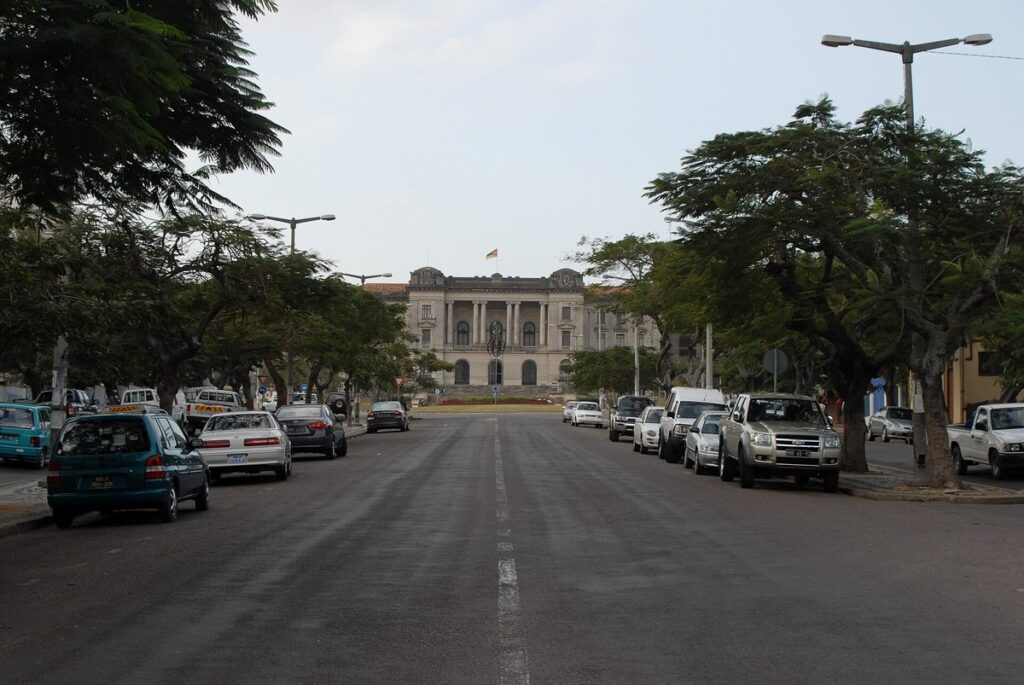
Photo: F Mira from Lisbon, Portugal / Wikimedia Commons (CC BY-SA 2.0)
Mozambican President Daniel Chapo has promulgated a revision to the country’s 2026 Economic and Social Plan and State Budget, incorporating 3.574 billion meticais in carried-over natural gas revenue balances into public investment, with the additional resources designated for reconstruction of infrastructure damaged by natural disasters.
A statement from the Presidency on Thursday, November 19, said Chapo had determined that the legislation, previously approved by the Assembly of the Republic, did not contravene the Constitution. He ordered its promulgation and publication.
The Presidency said the additional resources, equivalent to approximately €47.4 million at current exchange rates, would support the restoration of economic and social infrastructure damaged by natural disasters. The intended spending includes roads, bridges, water supply systems, schools, health facilities, and buildings used by public administration and the justice system.
The statement presented the measure as a way to finance reconstruction while ensuring what it described as legality, transparency and good governance in the management of public finances. It did not identify the natural gas project or field from which the carried-over balances originated, or specify the year in which the revenue was first received.
During parliamentary debate, Frelimo MP Faisal António argued that the revision would translate natural resource revenues into practical benefits for the population. He highlighted infrastructure rehabilitation, support for agriculture and the restoration of essential public services as areas in which the additional funding could make a difference.
The Assembly definitively approved the revision on October 24 during an extraordinary session. The measure received 164 votes in favour from members of the ruling Frelimo party, while 62 members voted against. The opposition votes came from all three opposition parties represented in the debate: the Democratic Movement of Mozambique (MDM), the Mozambican National Resistance (Renamo) and Podemos.
The opposition challenged both the government’s budget management and the timing of the revision. MDM described the proposal as a “certificate of incompetence” on the government’s part, criticising its planning and execution of expenditure. The party argued that only two months remained in the financial year in which to implement the proposed measures.
Renamo called for available resources to be directed first towards accumulated debts owed to teachers, contractors and State suppliers. It also questioned the need for an extraordinary parliamentary session held only days before the Assembly’s ordinary session.
Podemos pointed to what it called a “blatant contradiction in timing”, questioning the urgency of the revision as the financial year approached its end. The party also called for greater attention to health, education and culture.
The revised budget increases projected domestic resources from 442.9527 billion meticais, approximately €5.965 billion, to 446.5273 billion meticais, or about €6.013 billion. The revised figure represents 27.3 percent of gross domestic product.
Public expenditure is also set to rise, from 520.6342 billion meticais, approximately €7.012 billion, to 524.2088 billion meticais, or about €7.060 billion. The revised expenditure total is equivalent to 32.1 percent of GDP.
The figures reflect increases of 3.5746 billion meticais in both domestic resources and public expenditure. The revision does not, in the information provided by the Presidency, include a sector-by-sector allocation or a timetable for the reconstruction spending. It also does not specify a deficit figure.
The decision comes as Mozambique continues to develop its substantial natural gas resources in the Rovuma Basin, in Cabo Delgado province. The basin holds reserves considered among the largest in the world and has three approved megaprojects.
Two of those developments, led by TotalEnergies and ExxonMobil and valued together at approximately US$30 billion, are still awaiting final investment decisions. Eni’s Coral Sul floating liquefied natural gas facility has been producing since 2022. The company plans to develop the Coral Norte platform from 2028, with an estimated investment of US$7.2 billion.
The Presidency’s statement did not link the 3.574 billion meticais in carried-over revenue to any of the named projects. Nor did it identify a particular disaster, affected region or individual reconstruction project. The stated purpose is to direct the additional public resources towards restoring damaged infrastructure and supporting reconstruction, with the practical allocation and timing of expenditure not specified.
Maya Wilson
World Desk Lead, The Library Media
From The Library — the estate of our family.
Follow Us


