
The Library Media — National & World · World Desk
By Maya Wilson
Prospects for a unity government in Israel appeared to have collapsed on Monday, with senior officials in the bloc led by Gadi Eisenkot saying the affair surrounding the election-day arrests of Arab activists had eliminated even the limited possibility of forming a government with Prime Minister Benjamin Netanyahu’s Likud party.
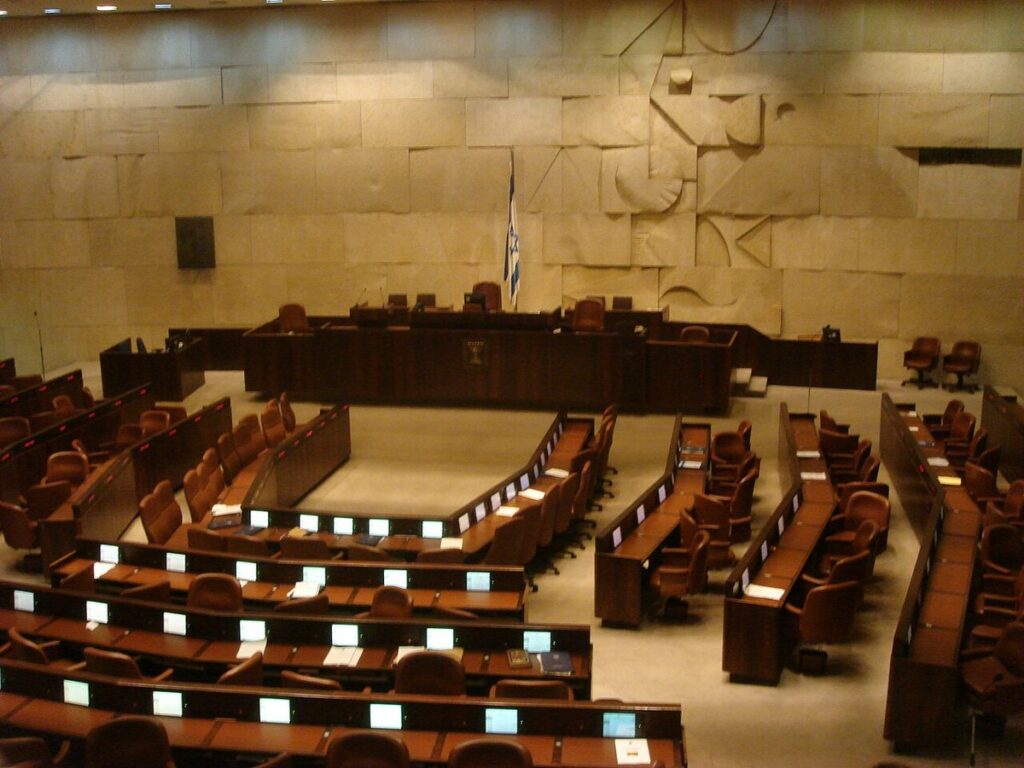
Photo: Photo: The Knesset plenum hall in Jerusalem (Beit HaShalom / Wikimedia Commons)
The officials, cited by Israel’s public broadcaster Kan and reported by The Times of Israel, characterized the events as “no less than an attempted coup.” The phrase reflects the Eisenkot bloc’s assessment of the affair, not an established finding about what occurred.
The dispute centres on reports that Netanyahu’s office was actively involved in facilitating the arrests of Arab activists on election day. Netanyahu has since seized on the arrests to argue that the election was stolen.
Following the arrests, police said officers had recovered envelopes containing tens of thousands of shekels in cash. Netanyahu claimed that Arab parties were stealing the vote and urged his supporters to go to the polls.
But the three people arrested have all since been released without restrictive conditions or charges. After one of them was freed, a local court sharply criticized investigators’ conduct. It has also since emerged that the police complaint that triggered the arrests originated from Netanyahu’s office, while the alleged election-fraud investigation has faced growing scrutiny from prosecutors.
Eisenkot and Netanyahu met on Sunday for talks on forming a unity government. The meeting did not resolve the tensions, and the continuing bad blood has fuelled strongly worded public attacks between the two political camps.
An unnamed senior official in Eisenkot’s bloc told Kan that the affair had destroyed the remaining basis for cooperation with Likud. The official also argued that Shin Bet chief David Zini and Mossad chief Roman Gofman should be fired.
The official cited two additional episodes as having damaged trust. One was Netanyahu’s speech at the Knesset swearing-in, in which he lambasted Arab-led parties as supporters of terrorism. The other was Netanyahu’s alleged concealment of Gofman’s planned trip to the United States during the unity-government talks. According to the account, the trip was due to take place only hours after the meeting. The reporting did not specify the destination city, purpose or date of the visit.
Kan separately reported that Eisenkot and his allies intend to establish a state commission of inquiry to investigate the Shin Bet and police over the alleged election-fraud investigation. That proposed inquiry would address the conduct surrounding the arrests and the investigation that followed.
The government-formation dispute is unfolding alongside a separate confrontation over accountability for the Hamas-led October 7, 2023, assault on Israel.
On Monday, bereaved families represented by the October Council accused Eisenkot’s bloc of sidelining its commitment to establish a state commission of inquiry into the failures surrounding the October 7 attacks. The organization represents survivors of the attacks, former hostages and bereaved families.
According to Ynet, the bloc has put on hold legislation that would allow a state commission of inquiry to be established without a government decision. The report said the bloc reportedly believes it may not have enough time to pass all the legislation it has promised if no government is formed and Israel proceeds to another election.
The families rejected the delay. In a message to bloc leaders reported by Ynet, the October Council said: “Your time is running out, and so is our patience. First, a state commission of inquiry, then your politics.”
The Council warned that it would launch an “uncompromising public struggle” if the bloc continued to postpone the legislation.
The two disputes place Eisenkot’s political leadership under pressure from different directions: the election-day arrests affair has further weakened the prospects of cooperation with Netanyahu, while families affected by the October 7 attacks are demanding that the bloc honour its commitment to an independent inquiry.
The Knesset was sworn in on November 10, and Eisenkot holds President Isaac Herzog’s mandate to form a government. Netanyahu remains caretaker prime minister. The Knesset is scheduled to vote on a new speaker on Tuesday, November 17.
The latest reporting points to a deepening breakdown in the unity talks, but the allegations surrounding the arrests, the conduct of officials and the claimed concealment of Gofman’s travel remain matters of scrutiny and dispute.
Update — Tuesday: The Knesset voted 66–52 on Tuesday to elect Matan Kahana of Eisenkot’s Yashar party as speaker, after a six-hour filibuster by the Netanyahu bloc. Kahana, a former air force pilot, said in his first remarks as speaker that the next government will respect court rulings and work for the good of all Israelis. The vote gives the Eisenkot bloc control of the legislative agenda as government formation proceeds.
The same day, the Central Elections Committee said the Shin Bet investigation into alleged vote-buying in the Arab community in the October 27 election had found no evidence of bribes being paid to voters on a scale that could affect the results. The statement, authorized by committee chairman Noam Sohlberg and issued with the consent of Shin Bet chief David Zini, said the investigation continues but is shifting toward security-related matters, including subversion and foreign influence. The three Ra’am activists arrested on election day have all been released, and the case now appears likely to be closed without charges — a further blow to Netanyahu’s claim that the election was stolen. A court has separately given Likud more time to appeal the results. (The Times of Israel)
Maya Wilson
World Desk Lead, The Library Media
From The Library — the estate of our family.
Follow Us


