
The Library Media — National & World · National Desk
Federal Jury Convicts Man of Starting the Deadly 2025 Palisades Fire in Los Angeles
By Eleanor Ever Loyal
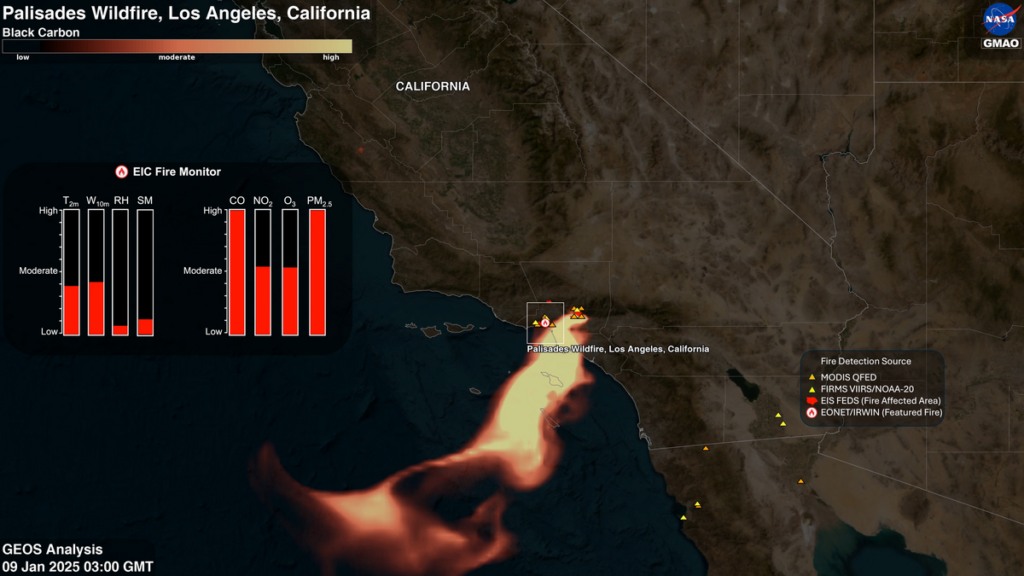
Photo: NASA’s Scientific Visualization Studio – NASA/GSFC/Joseph V. Ardizzone, Science / Wikimedia Commons (Public domain)
A federal jury in Los Angeles convicted Jonathan Rinderknecht on Friday of arson charges for starting the January 2025 fire that later became the deadly Palisades Fire, one of the most destructive wildfires in California history. The verdict followed a retrial after jurors in his first federal trial earlier this year could not reach a unanimous decision.
Prosecutors said Rinderknecht, 30, lit a fire on January 1, 2025, that continued burning undetected in deep root systems before flaring up six days later, on January 7, as the Palisades Fire. The blaze killed 12 people, destroyed entire neighbourhoods in Los Angeles and Malibu, California, and consumed about 6,800 structures, according to figures reported by Reuters.
Rinderknecht had pleaded not guilty to two federal charges: destruction of property by means of fire and arson. Jurors convicted him on both. The first charge was narrowed in the retrial to cover the January 1 blaze, known as the Lachman Fire; the second concerned the Palisades Fire. Each offence carries a potential prison sentence of up to 20 years, according to Los Angeles City News Service and KABC-TV, as reported by Reuters.
The first trial ended in June after a two-week proceeding in which jurors deadlocked 10 to 2 in favour of acquittal. Prosecutors dropped a third charge, timber set afire, when they filed a new indictment for the retrial.
The prosecution presented a more tightly organised case the second time, relying on digital forensic evidence, expert testimony and evidence about Rinderknecht’s state of mind in the hours before the initial fire. Prosecutors placed less emphasis than in the first trial on an alleged motive of resentment towards wealthy and powerful people as a form of “societal revenge.”
Evidence presented to jurors included photographs of Rinderknecht’s car parked at the base of a trail leading towards the area where the fire began. Cellphone tower data was used to track his movement on the hill, while images from fire-detection cameras helped establish the period in which the blaze ignited. Government experts said they had eliminated other possible sources of ignition that night, including fireworks.
Prosecutors also presented Uber passenger accounts and text messages to Rinderknecht’s girlfriend at the time to describe his behaviour in the hours leading up to the fire. Assistant U.S. Attorney Mark Williams said: “He was mad at everything, and frustrated.”
After the fire began, Rinderknecht called 911 more than a dozen times while walking down the hill. Prosecutors showed jurors a video he had screen-recorded on his phone during the calls. They also presented evidence that he asked ChatGPT: “Are you at fault if a fire is lit because of your cigarettes?” Prosecutors argued that the calls and the question were part of an effort to create an alibi.
Fire investigators testified that the Palisades Fire was a holdover fire from the initial blaze. Jurors were instructed not to consider the Los Angeles Fire Department’s role in extinguishing the fire.
Defence attorney Steve Haney challenged the government’s account, arguing that its evidence did not prove Rinderknecht started the blaze. He said the scene could have been compromised because the area remained accessible to the public between the January 1 fire and the January 7 outbreak. “Six days of anyone and everyone walking across the spot the government now calls a crime scene,” Haney told jurors.
The defence called its own expert witnesses, including a retired U.S. Forest Service fire investigator who disputed the government’s conclusion about where the fire began. Haney also argued that missing cellphone records prevented prosecutors from establishing that nobody else was at the ignition point. He pointed to a neighbour’s testimony that a group of teenagers had been seen running away from the direction of the trailhead.
Haney urged jurors to disregard evidence about Rinderknecht’s character, including angry text messages, saying they were “evidence of the man, not evidence of the act.” The defence also advanced fireworks as an alternative explanation. Multiple witnesses, including two neighbours and a local firefighter, testified that they heard a loud bang or explosion from the direction of the hill. Prosecutors countered that none of the thousands of images collected from cameras in the area that evening showed fireworks in the sky above the fire’s starting location.
Jurors deliberated for nearly three days after closing arguments on Tuesday, NBC News reported. Rinderknecht, a former Uber driver and former Pacific Palisades resident, showed little apparent reaction as the verdict was read. He hugged his attorneys before leaving the courtroom. His father was present during the trial and when the verdict was announced.
The conviction concludes the retrial, but sentencing remains ahead. Each of the two offences carries a maximum sentence of 20 years in prison; the verdict does not itself determine the sentence.
Eleanor Ever Loyal
Lead Counsel & National Desk, The Library Media
From The Library — the estate of our family.
Follow Us


