
The Library Media — World
Brazil Supreme Court Justice Votes to Maintain Restrictions on Senator Flávio Bolsonaro
By Maya Wilson
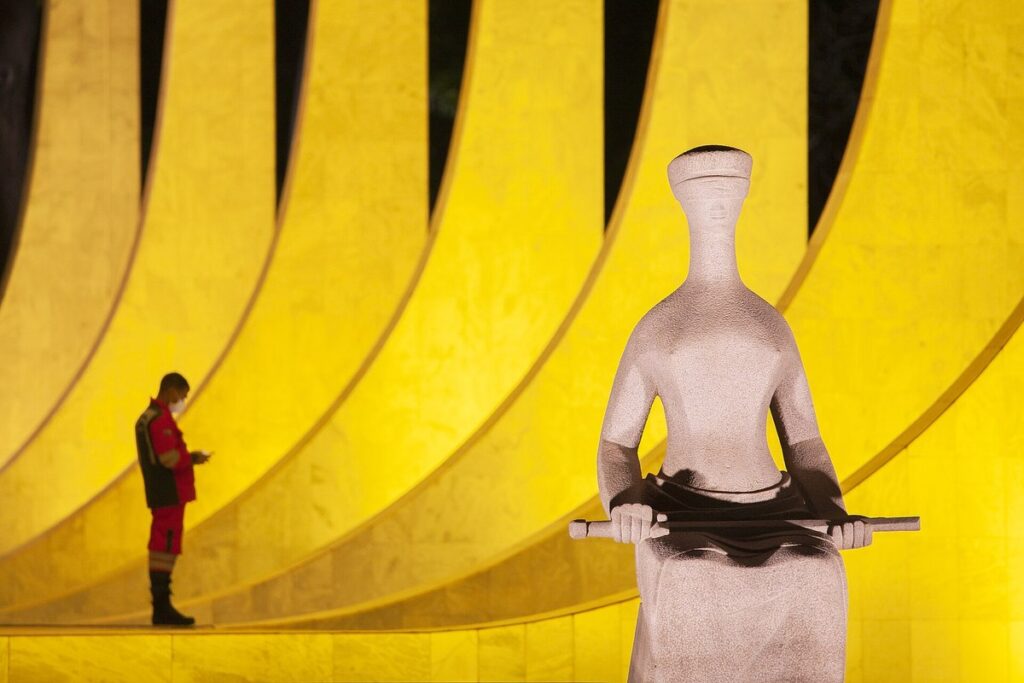
Photo: Dasfour2022 / Wikimedia Commons (CC BY-SA 4.0)
Justice Alexandre de Moraes of Brazil’s Supreme Federal Court voted on Friday to maintain precautionary measures imposed on Senator Flávio Bolsonaro, including the surrender of his passports and a prohibition on contact with other people under investigation, according to G1, TV Globo’s news portal.
The vote, reported by G1 in an article by Márcio Falcão from Brasília, is not a final decision by the court. The Supreme Federal Court’s First Panel began hearing the case on Friday in a virtual plenary session, considering an internal appeal by Flávio’s defence against the restrictions Moraes had ordered. Other justices may enter their votes in the court’s electronic system until November 30.
Moraes is the rapporteur of the inquiry. G1 reported only his vote; it did not identify any other justice’s position or provide a vote count. The panel’s eventual decision therefore remains pending.
The restrictions described by G1 include the surrender of Flávio’s passports and a ban on contact with other people under investigation. One person covered by the contact restriction is Willer Tomaz, whom the report describes as Flávio’s lawyer and friend. G1 presents these as examples of the measures, not as a complete list.
In his vote, Moraes argued that Flávio had disobeyed a court order to hand over his passports and had left Brazil despite being prohibited from leaving the country. G1 reported that the justice treated the departure for the United States as a matter of public knowledge and said the conduct had the potential to obstruct the investigations.
Moraes characterised the departure as flight from the jurisdiction, using the phrase “fuga do distrito da culpa.” He said the investigations remained under way and that the restrictions were necessary to ensure the effectiveness of the proceedings.
The justice also rejected the defence’s arguments for changing the earlier decision. As paraphrased by G1, he concluded there was nothing to correct in his previous reasoning — “não há reparo a fazer” — because the appeal had presented no argument capable of undermining the grounds on which the measures were imposed.
The investigations are described in G1’s report as ongoing inquiries into alleged money laundering. The article does not identify any other investigation, specify an amount of money, give a date for an alleged offence or describe a specific act of alleged money laundering.
The report also leaves important details about Flávio’s departure unanswered. It gives no date or route for his travel to the United States and does not identify where in the country he landed. A photograph caption says he landed in the United States after fleeing Brazil; the photograph is credited to Eva Marie Uzcategui/Reuters.
G1 does not provide further detail about the original passport order beyond Moraes’s finding that Flávio failed to comply with it. Nor does the report include a response from Flávio, his family, his party, other members of the court or prosecutors.
The account also makes no statement about enforcement measures or possible consequences involving arrest or extradition. It does not establish what steps, if any, authorities may take in relation to Flávio’s presence in the United States.
For now, the reported action is a single justice’s vote to preserve the restrictions while the First Panel considers the defence appeal. The other justices have until November 30 to enter their votes. Until that process is complete, Moraes’s position should not be read as a final ruling by the panel.
Maya Wilson
World Desk Lead, The Library Media
From The Library — the estate of our family.
Follow Us


