
The Library Media — Science, Technology & Health · AI News & Intelligence Desk
The Model Is the Robot Now: OpenAI Folds Its Robotics Team Into the Labs Building GPT-6 Astra
By Maya Wilson
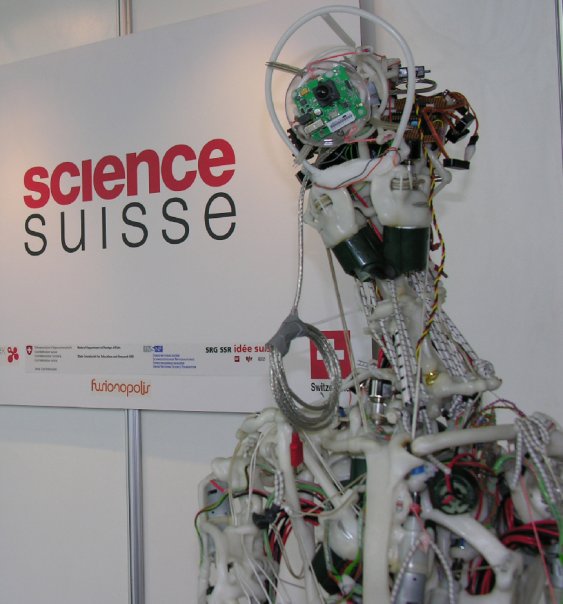
Photo: Science Swiss @ Singapore / Wikimedia Commons (CC BY-SA 3.0)
OpenAI has disbanded its stand-alone robotics team and reassigned its staff, folding the work into the organisations building and applying its broader artificial intelligence models, Fortune reported exclusively on November 13. OpenAI confirmed the reorganisation to Fortune on the record when asked.
The change does not represent a withdrawal from robotics, according to an OpenAI spokesperson who spoke to Fortune. Robotics remains a core part of the company’s long-term vision, the spokesperson said, describing the reorganisation as an effort to accelerate the work. A demonstration involving a humanoid robot is still targeted for 2027.
The researchers from the former robotics group are moving into OpenAI’s main research organisation, where they will report to Chief Research Officer Mark Chen. Applied robotics and hardware staff are moving into the larger Applied organisation, reporting to President Greg Brockman, according to Fortune’s reporting and OpenAI’s confirmation.
The reasoning behind the move marks a shift in how OpenAI says it now views the relationship between general-purpose AI and robotics.
According to the OpenAI spokesperson’s account to Fortune, researchers at the beginning of the year believed the most effective path into robotics would run through models such as Sora, OpenAI’s video generator. The idea was that such models would need to develop an implicit understanding of how the physical world behaves.
Since then, OpenAI has concluded that general-purpose frontier models, including GPT-6 Astra, can be applied directly to robotics, Fortune reported. That finding prompted the company to place robotics researchers alongside the teams building the general models rather than maintain a separate robot-specific organisation.
A simulation result, not a physical robot demonstration
The evidence OpenAI has pointed to was reported by Fortune from an Nvidia study and concerns a simulated benchmark rather than a physical robot performing a physical task.
Researchers gave GPT-6 Astra camera images, information about a robot’s state and a control interface through which it could command a robot in RoboLab-120, a simulated manipulation benchmark. An Astra-powered agent reached a 74.8% success rate, according to the study as reported by Fortune.
The best specialised robot model listed on that leaderboard, Lakeside, reported a 51.0% success rate. Fortune reported that Astra had received no special robot training for the task.
The comparison is therefore evidence from simulation, not evidence that a physical robot has completed a physical job using the model. The study was conducted by Nvidia, a company with an interest in robotics.
OpenAI’s reorganisation reflects its view, as described to Fortune, that the general frontier model may increasingly serve as the intelligence directing a robot rather than requiring a separate, specialised AI development path.
This is also the second time OpenAI has closed a robotics team. The first closure, in 2020–21, was a retreat from the field, according to the history cited in Fortune’s report.
This time, OpenAI told Fortune, the company is presenting the decision differently: not as leaving robotics behind, but as bringing robotics into the same development structure as its most advanced general-purpose models.
Maya Wilson
AI News & Intelligence Desk, The Library Media
From The Library — the estate of our family.
Follow Us


