
The Library Media — National & World · World Desk
Ukraine Says It Struck the Ilsky Refinery and Oil Depots in Russia’s Rostov Region; Moscow Reports Fires and Injured
By Maya Wilson
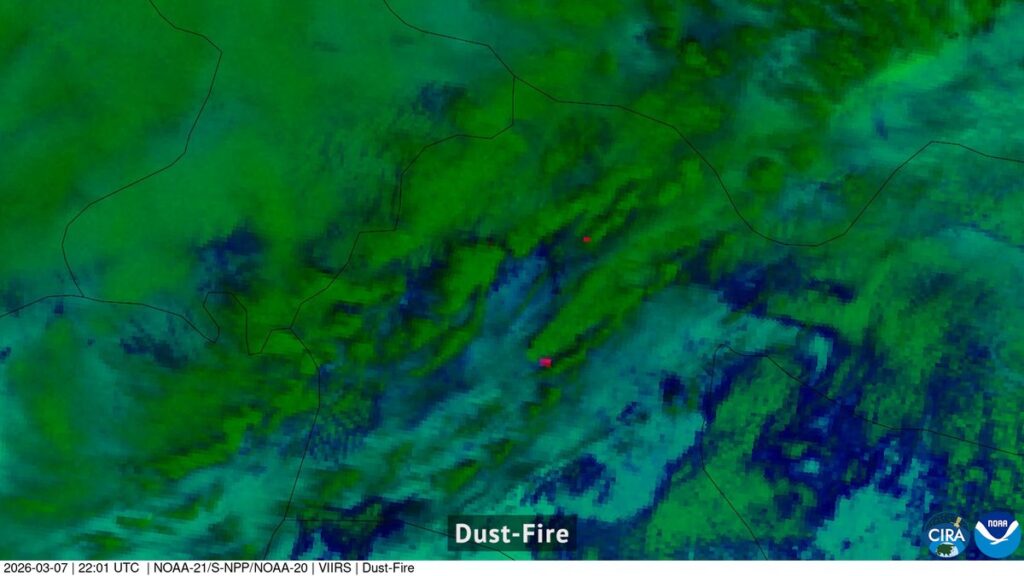
Photo: JPSS imagery: CSU/CIRA & NOAA/NESDIS / Wikimedia Commons (Public domain)
Ukraine’s Defense Forces say they struck an oil refinery, two oil depots and Russian command posts in attacks carried out on November 15 and overnight into Monday, November 16. Russian regional officials confirmed fires at industrial sites in the affected areas and reported injuries, but their accounts do not independently establish that the Ukrainian strikes hit the specific oil facilities claimed by Kyiv.
Ukraine’s General Staff said the operations targeted the Ilsky Oil Refinery in Russia’s Krasnodar region, two oil depots in Azov in the Rostov region, and Russian command posts. Ukrinform carried the Ukrainian military’s account. The reported targets place the attacks within Ukraine’s continuing effort to disrupt Russian fuel infrastructure and military operations, but the claims about the results must be distinguished from what Russian authorities have acknowledged.
In Rostov region, Governor Vasily Slyusar reported fires at four industrial sites in Azov and said three men had been injured. His account confirmed fires and casualties in the city, but did not establish that the two oil depots named by Ukraine were among the facilities struck.
The reported injury toll in Russian accounts is also inconsistent. One rendering of the regional reports gives three injured, including a child, while another gives six. Those figures cannot be reconciled from the reporting available and should not be treated as a settled total.
In Krasnodar region, local authorities confirmed a fire at an unnamed enterprise in the village of Ilsky. They also reported injuries caused by falling debris in Seversky district. That confirmation is narrower than Ukraine’s claim that the Ilsky Oil Refinery was targeted. The Russian account did not identify the burning enterprise as the refinery, and the available information does not establish that the refinery itself was hit.
The distinction is important because a fire in the same village is not, by itself, confirmation that a named industrial facility sustained damage. Ukraine’s General Staff has identified the refinery as a target; Russian authorities have confirmed a fire at an unnamed enterprise. The two accounts leave the precise site and extent of any damage unresolved.
Wire-service roundups also reported that two people were killed inside Russia during the overnight exchanges. One death was reported in Belgorod region and confirmed in coverage by Al Jazeera. The location of the second reported death is not established in the available accounts. Those reports should be kept separate from the injuries reported by the Rostov and Krasnodar regional authorities.
The attacks come amid competing assessments of the damage Ukraine has inflicted on Russia’s oil-processing capacity. President Volodymyr Zelenskyy has said Ukrainian strikes have disabled more than 55% of Russia’s refining capacity. Reuters, citing industry sources, has put the figure nearer 30%. The estimates differ substantially and reflect distinct attributed assessments; neither should be presented as an independently established figure in this account.
The difference matters to the broader question of how much Ukraine’s campaign has constrained Russian fuel production. Refinery strikes can disrupt processing, but assessing their cumulative effect requires evidence about facilities damaged, the duration of outages and the capacity restored or replaced. The competing figures from Zelenskyy and Reuters’ industry sources underline that uncertainty.
The latest claims also sit within a wider pattern of attacks on infrastructure and industrial sites during the war. The Library Media’s companion report, S-620, covers the latest Russian strikes on Ukrainian cities and infrastructure. That coverage provides the other side of the continuing exchange without changing the casualty figures or claims reported here.
For now, the confirmed picture is more limited than the Ukrainian target list. Kyiv says its forces struck the Ilsky refinery, two Azov oil depots and Russian command posts. Russian officials have reported fires at four industrial sites in Azov, a fire at an unnamed enterprise in Ilsky village and injuries, but have not confirmed that the named refinery or depots were hit. The conflicting injury totals remain unresolved, and the available reporting does not establish the extent of damage to the facilities Ukraine identified.
Maya Wilson
World Desk Lead, The Library Media
From The Library — the estate of our family.
Follow Us


