
The Library Media — National & World · National Desk
Federal Appeals Court Rules House Unconstitutionally Passed $1.7 Trillion Spending Package Using Proxy Votes
By Eleanor Ever Loyal
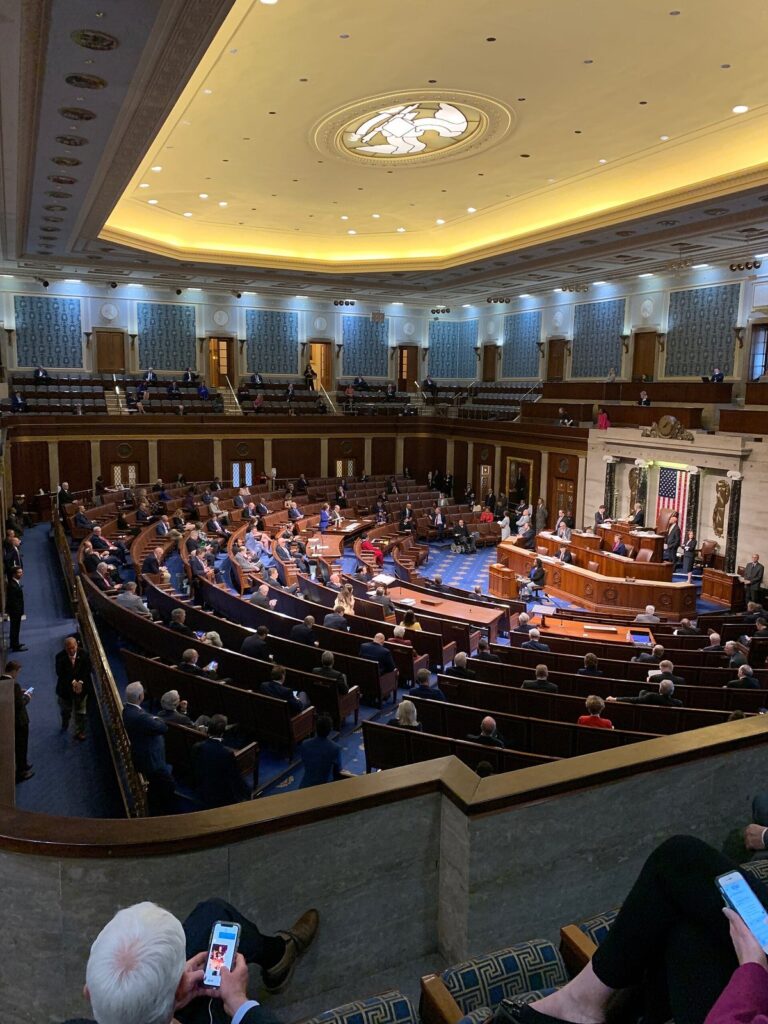
Photo: Josh Harder / Wikimedia Commons (Public domain)
A federal appeals court ruled Friday that the House of Representatives unconstitutionally passed a $1.7 trillion government funding package in 2022 because it relied on pandemic-era proxy voting, holding that the procedure violated the Constitution’s Quorum Clause.
The New Orleans-based 5th U.S. Circuit Court of Appeals voted 9–8 to find that the House’s proxy-voting rule was unconstitutional. The majority said the clause requires a majority of House members to be physically present for legislation to pass.
“While the chambers of the legislature have much discretion regarding their rules of procedure, the Quorum Clause’s constraints on congressional power cannot be circumvented by congressional fiat,” the majority wrote.
The opinion was written by U.S. Circuit Judge Cory Wilson, an appointee of President Donald Trump. U.S. Circuit Judge James Graves, an appointee of former President Barack Obama, wrote the dissent.
The case concerned a $1.7 trillion spending package that the House passed in 2022 by a vote of 225–201. A total of 226 members voted by proxy. The legislation included the Pregnant Workers Fairness Act, which provides pregnant workers with stronger legal protections, and was signed into law by President Joe Biden.
The House introduced proxy voting in May 2020 under then-Speaker Nancy Pelosi as an emergency measure during the COVID-19 pandemic. The practice was discontinued after Republicans took control of the House following the November 2022 elections.
The legal challenge was brought by Texas Attorney General Ken Paxton, whom Reuters described as the outgoing attorney general. Paxton sued over the pregnant-workers provision and obtained an injunction blocking its enforcement. Friday’s 9–8 ruling upholds that injunction.
Friday’s ruling leaves the practical relief narrow despite the majority’s broader constitutional reasoning about how the spending package was passed. The decision bars only the U.S. Department of Justice and the Equal Employment Opportunity Commission from enforcing the Pregnant Workers Fairness Act against Texas. It does not, according to Reuters’ account, bar enforcement of the provision against other parties.
Graves sharply disputed the majority’s constitutional interpretation and the limited scope of the relief. He called the ruling “illogical, inexplicable, and invalid,” arguing that the majority had read a physical-presence requirement into the Quorum Clause that the Constitution does not contain.
He also questioned why, if the entire law had been passed unconstitutionally, the court limited its ruling to one small part of a multitrillion-dollar spending package.
The decision thus presents a distinction between the constitutional reasoning adopted by the majority and the specific enforcement restriction imposed in the case. The court’s holding concerns the House procedure used to pass the legislation, while the relief described by Reuters applies only to federal enforcement of the pregnant-workers provision against Texas.
The Justice Department, which defended the law, and Paxton’s office did not respond to Reuters’ requests for comment.
Reuters did not report whether either side intends to pursue a further appeal, whether a route to the Supreme Court is being considered, or when any additional action might take effect. The next step in the litigation therefore remains unclear.
Eleanor Ever Loyal
Lead Counsel & National Desk, The Library Media
From The Library — the estate of our family.
Follow Us


