
The Library Media — World · World Desk
South Korean Court Acquits Daegu Mayor Choo Kyung-ho in Martial-Law Insurrection Case
By Maya Wilson, World Desk Lead
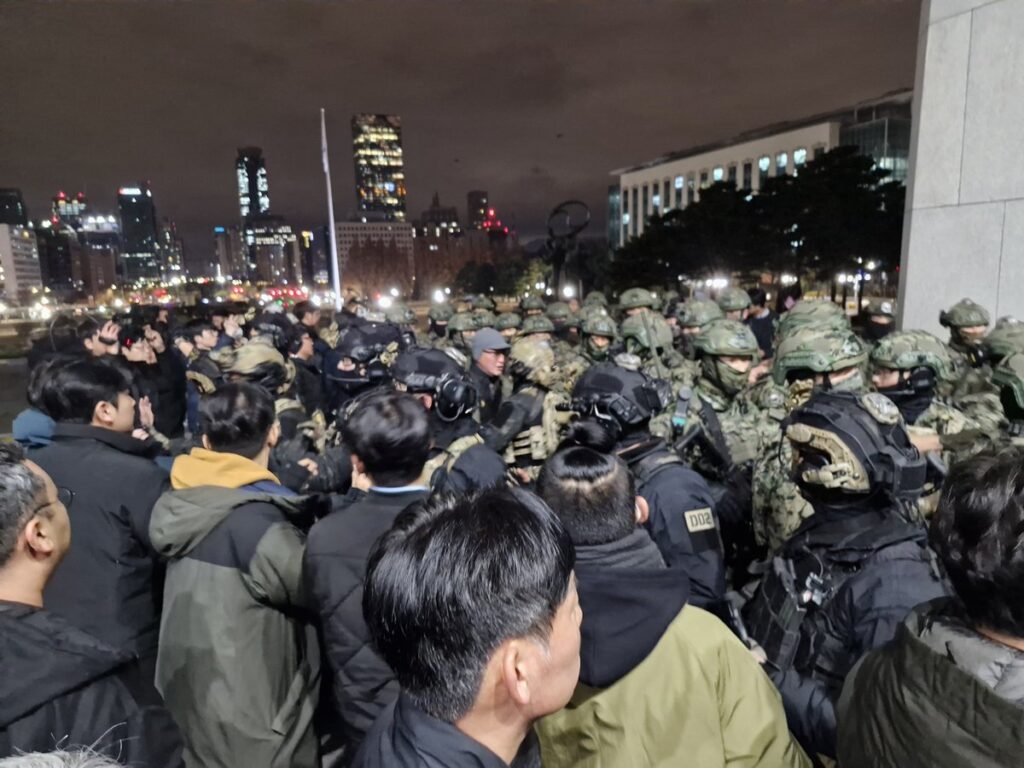
Photo: South Korean soldiers outside the National Assembly in Seoul during the December 2024 martial-law crisis — mujjingun / Wikimedia Commons, public domain.
The Seoul Central District Court acquitted Daegu Mayor Choo Kyung-ho on Wednesday, November 18, in the first-instance trial over his alleged role in the December 2024 martial-law crisis, rejecting the insurrection special counsel’s case that he deliberately helped prevent lawmakers from voting to lift the decree.
The Criminal Division 34 court, presided over by Judge Han Sung-jin, cleared Choo of engaging in an important duty of an insurrection. The special counsel team, led by Cho Eun-seok, had indicted Choo about 11 months earlier. He was tried without detention.
Choo was the floor leader of the then-ruling People Power Party in December 2024. Prosecutors argued that then-President Yoon Suk Yeol asked Choo to cooperate with the martial-law decree and that Choo repeatedly changed the location of an emergency PPP lawmakers’ caucus to prevent party lawmakers from participating in the National Assembly’s vote to lift it.
Choo initially convened the caucus at the National Assembly at about 11 p.m. on December 3, 2024. Prosecutors said he then changed the location three times, moving between the Assembly and party headquarters: Assembly, party headquarters, Assembly and party headquarters.
Of the PPP’s 108 lawmakers, 90 did not participate in the Assembly vote, while 18 did. The National Assembly ultimately voted 190-0, with all 190 lawmakers present voting to demand that the martial-law decree be lifted. Yoon lifted the decree hours later.
The special counsel also argued that Choo understood the declaration to be unconstitutional and illegal through successive telephone calls with senior presidential secretary for political affairs Hong Chul-ho and then-Prime Minister Han Duck-soo, and nevertheless voluntarily joined the insurrection. At closing arguments in September, prosecutors sought a 20-year prison sentence, arguing that Choo had abandoned his constitutional duty as a lawmaker to check martial law and had actively participated in an insurrection.
Choo denied the allegations throughout the proceedings. He said he had no advance knowledge of the declaration, never received a request from Yoon concerning the vote and never accepted such a request. In September, he said: “I never received any request from the President regarding the vote, nor did I accept such a request.”
His defence argued that the repeated venue changes reflected the chaos of the night, when troops entered the National Assembly and police controlled access, making it difficult for lawmakers to enter. In his final statement, Choo expressed regret that he had not communicated more carefully with lawmakers during the changes but said he had no intention of obstructing the resolution to lift martial law.
The court’s reasoning, as reported by Seoul Economic Daily, was that it was difficult to conclude that Yoon had asked Choo to block the vote. The court further found that even if such a request had been made, the evidence presented by the special counsel alone was insufficient to establish that Choo accepted it.
The acquittal removes, at first instance, the threat to Choo’s position as Daegu mayor. A prison sentence or heavier punishment would have resulted in the loss of the mayoralty under the Public Official Election Act.
No post-verdict reaction from Choo, the People Power Party, the opposition or the special counsel had been reported at publication time. No decision by the special counsel on whether to appeal the acquittal had been reported either.
The ruling comes as other martial-law accountability cases reach critical stages. The Supreme Court has just finalised former National Intelligence Service chief Cho Tae-yong’s 2½-year prison term in the martial-law case. The Supreme Court’s full bench is due to deliberate former Prime Minister Han Duck-soo’s case on Thursday, November 19. Yoon was convicted in February 2026 of leading an insurrection and sentenced to life imprisonment; his appeal verdict is scheduled for January 26, 2027.
Maya Wilson
World Desk Lead, The Library Media
From The Library — the estate of our family.
Follow Us


