
The Library Media — National & World · World Desk
China Is Building a Nearly Three-Kilometre Runway on Antelope Reef in the Paracels
By Maya Wilson
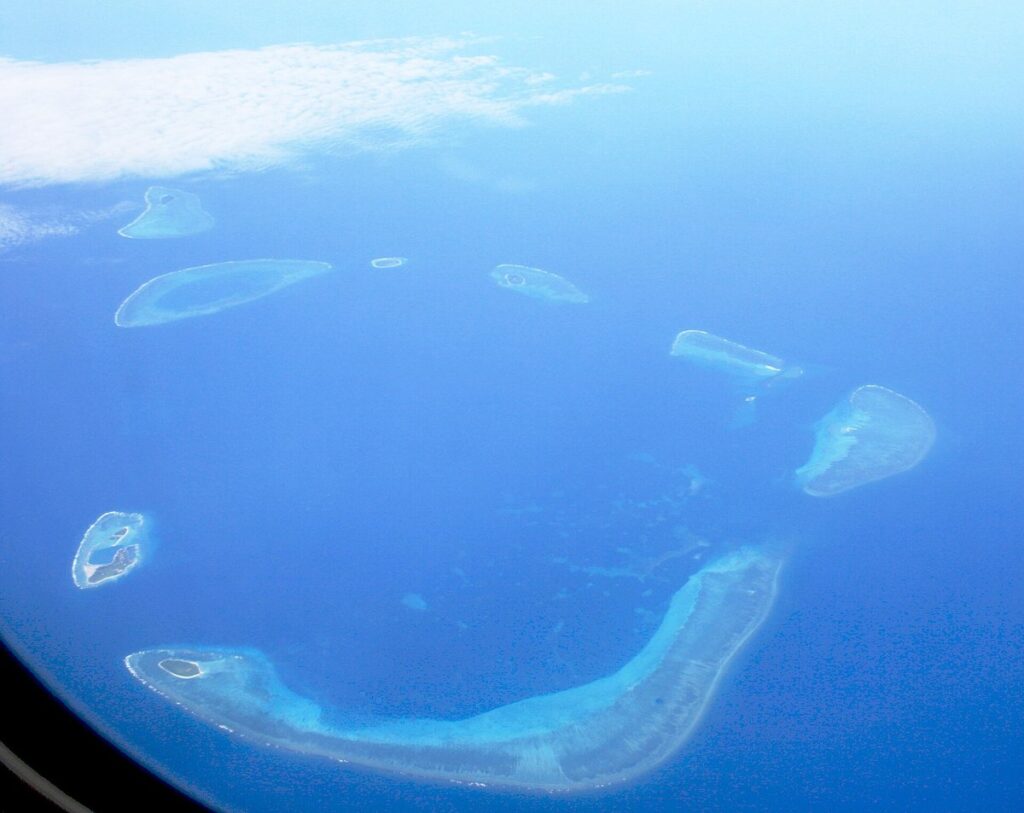
Photo: Crescent_Group,_Paracel_Islands,_2007-08-11.jpg : Swaminathan derivative work: T / Wikimedia Commons (CC BY 2.0)
Satellite images taken in September show China building a runway nearly three kilometres long on Antelope Reef in the Paracel Islands, according to AFP reporting carried by Hong Kong Free Press on November 18. The structure, clearly visible in images captured by Planet Labs, would become Beijing’s second runway in the Paracels. It remains under construction, with analysts expecting it to become operational by mid-2027.
The images were reviewed in a report by Japanese intelligence firm Deep Dive and were also examined by AFP. A separate image dated October 17 shows foundations for a harbour at the reef. Antelope Reef extends around six kilometres along its northwest-to-southeast axis.
The planned runway is similar in size to the existing airstrip on Woody Island, also in the Paracels, and to three airstrips China has built across the Spratly Islands. Analysts differ in how they assess the significance of the construction, although the runway and harbour development would add to China’s infrastructure and capacity across the disputed sea.
Lowell Bautista, author of a Lowy Institute report on the development, told AFP that China had transformed Antelope Reef in 10 months “from one of its smallest Paracel outposts into an island that can rival its largest atoll.”
Bautista said the runway, alongside infrastructure on the Spratly Islands and Hainan, would help “create an integrated network of runways, harbours and sensors stretching across the sea.” The assessment places Antelope within a wider system of facilities that could support China’s presence across the South China Sea.
Bonji Ohara, director of Deep Dive and a former Japanese defence attaché in China, said the runway could accommodate a range of aircraft beyond fighters. It would handle “not just fighter jets but also larger aircraft, including transport planes, aerial refuelling tankers and bombers,” he told AFP.
Ohara said the development could bring China closer to achieving “full control over the entire South China Sea.” He described Beijing’s view of the waterway as a sanctuary where it would seek to keep foreign powers out in a contingency. “While it will not restrict freedom of navigation in peacetime, if some incident occurs, China intends to prevent not only US naval forces but also those of its allies — for example, Australian submarines — from entering,” he said.
Harrison Prêtat, deputy director of the Asia Maritime Transparency Initiative at the Center for Strategic and International Studies, said the runway and harbour would “add additional capacity and resilience to the facility that enable China’s military and paramilitary operations in the South China Sea.”
He also cautioned against treating the construction as a complete restriction on other countries’ activities. Southeast Asian claimants, he told AFP, “have still largely maintained access to offshore resources and occupy their own outposts.” But Prêtat said international opposition had been weaker than expected given the scale of the work. He argued that regional countries, the United States and the wider international community “should be speaking with a stronger voice against island building.”
CSIS assesses that Antelope Reef could extend Chinese sensing capabilities closer to Vietnam’s coast and expand military capacity in the northern South China Sea, near major shipping lanes. The facility could become one of China’s most important outposts. Hunter Marston of the Lowy Institute told AFP that the Association of Southeast Asian Nations would struggle to coordinate a unified response: “ASEAN (member states) will never be capable of communicating with one voice.”
China, Vietnam and Taiwan all claim the Paracel Islands. Beijing has held de facto control since a 1974 skirmish in which more than 70 Vietnamese soldiers were killed. China began large-scale dredging and land reclamation at Antelope Reef late last year, according to reports by CSIS and the Lowy Institute.
Beijing claims most of the South China Sea despite an international ruling that its assertion has no legal basis. It has reclaimed land and built infrastructure across both the Paracel and Spratly chains. China says development in the Paracels is for civilian purposes, including improving conditions for a small resident population made up mostly of fishers. The existing runway network includes Woody Island, three Spratly airstrips and facilities on Hainan.
The Philippines, a US ally that does not claim the Paracels, has experienced years of confrontations with China elsewhere in the South China Sea, including ship collisions and injuries.
Official statements on the construction predate the latest report. China’s foreign ministry said in March 2026 that land reclamation in the Paracels was “necessary construction” to improve living and working conditions on the islands and grow the local economy. Vietnam said in August that construction at Antelope Reef was “completely illegal” and demanded that it cease immediately. Australia’s Defence Minister Richard Marles said in October that China’s military build-up was creating a “condition of pressure” in Southeast Asia.
There has been no same-day response to the November 18 report from Beijing, Hanoi, Washington or Manila.
Maya Wilson
World Desk Lead, The Library Media
From The Library — the estate of our family.
Follow Us


