
The Library Media — National & World · World Desk
By Maya Wilson
El Salvador will withdraw its troops from Haiti once a mission to locate four missing Salvadoran military personnel has been completed, Security Minister Gustavo Villatoro said Monday, signalling that the deployment may be temporary despite interest from Haiti’s government in extending the operation.
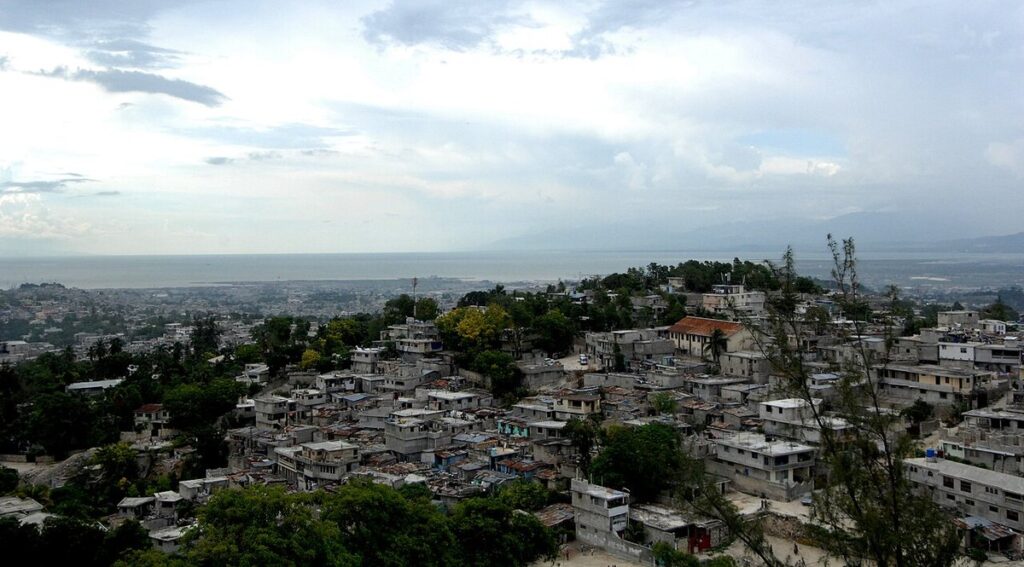
Photo: Photo: Port-au-Prince, Haiti (U.S. Navy photo by Chief Mass Communication Specialist James G. McCarter / Wikimedia Commons, public domain)
“If tomorrow the [air technicians] turn up, as President Bukele said, we will leave,” Villatoro told journalists at an event in San Salvador attended by Haiti’s Security Minister Patrick Pélissier. Villatoro was citing President Nayib Bukele’s position on the deployment.
The four missing men are Salvadoran air technicians serving with a United Nations-backed international anti-gang force. They disappeared after an attack by gang members near Port-au-Prince. Their whereabouts and status remain unknown. The report did not give a date for the attack.
Bukele sent more than 2,000 Salvadoran troops to Haiti at the end of October to help rescue the missing personnel. Since arriving, the contingent has taken part in operations that included an attack on the headquarters of the 400 Mawozo gang and the retaking, alongside Haitian police, of a base established in a football stadium that had been under criminal control for two years.
Villatoro’s remarks came amid questions about the objectives and scope of the Salvadoran deployment. While El Salvador has linked the mission to the search for its missing personnel, Haiti’s government has indicated that it would like the troops to remain and reinforce the broader campaign against armed gangs.
Pélissier said Haitian Prime Minister Alix Didier Fils-Aimé was preparing meetings with Salvadoran authorities to discuss extending the operation. The discussions would address whether the deployment should continue beyond its stated rescue purpose.
The terms governing the Salvadoran presence have not been made public. Vice President Félix Ulloa said the content of the security agreement between El Salvador and Haiti would be disclosed only “until diplomatic conditions allow it,” citing security reasons.
Amnesty International last week called for the agreement to be made public and for operations to guarantee respect for human rights. The organisation’s request adds scrutiny of the legal and operational framework under which foreign troops are participating in Haiti’s security campaign.
Salvadoran forces are not the only international or domestic actors involved in the effort against gangs. Haitian police and the Haitian army are operating alongside the Gang Suppression Force and a separate task force led by Vectus Global, a company belonging to U.S. businessman Erik Prince and working under contract with the Haitian government.
U.S. Secretary of State Marco Rubio has insisted that the various forces coordinate their operations to avoid confrontations.
The competing priorities leave the future of El Salvador’s deployment unresolved. Villatoro’s statement tied withdrawal to the recovery of the four missing technicians, while Haiti’s government is seeking discussions about a possible extension. No timetable for those talks or a final decision on the deployment’s duration was reported.
Maya Wilson
World Desk Lead, The Library Media
From The Library — the estate of our family.
Follow Us


