
The Library Media — Science, Technology & Health · AI News & Intelligence Desk
By Clara Ledger
The strategic case for combining Tesla and SpaceX has been framed around electric vehicles, artificial intelligence, satellite launches and social media. But Bloomberg’s November 14 reporting identifies a more immediate financial incentive: access to the S&P 500. A merger could give SpaceX an indirect route into an index it cannot yet join independently, potentially triggering an estimated $100 billion in passive demand for the combined company.
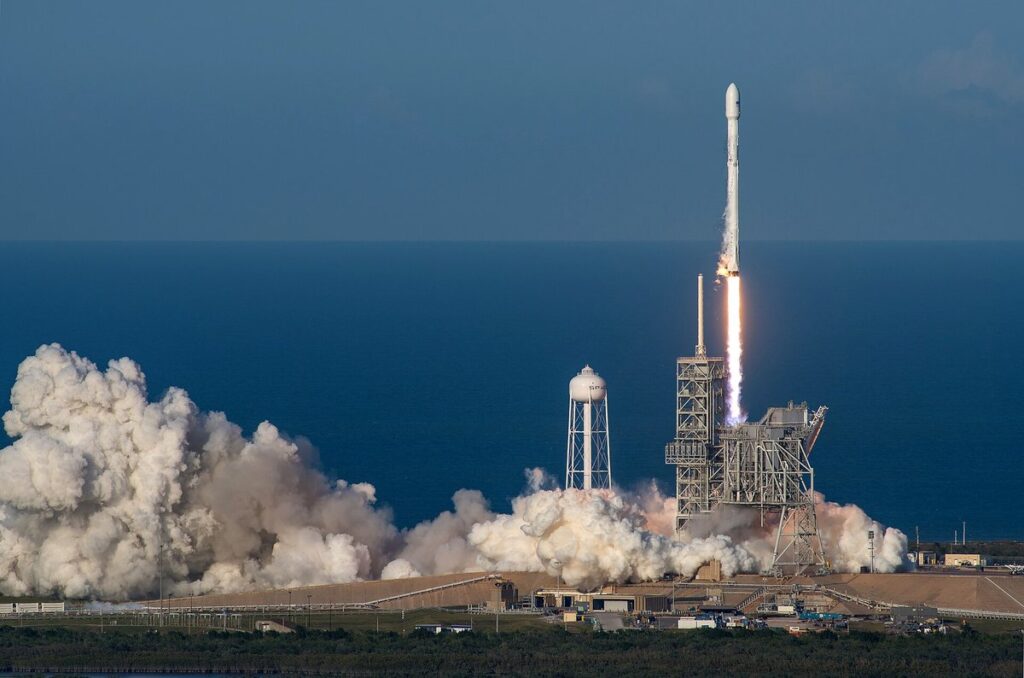
Photo: SpaceX / Wikimedia Commons (CC0)
According to Bloomberg, talks between the companies have progressed toward a tie-up consolidating their businesses. Elon Musk endorsed the idea last month and asked board members to consider it. People familiar with the discussions told Bloomberg that an announcement could come as soon as next month. Reuters separately reported on November 12 that a deal could arrive in December or early 2027. No terms have been agreed, and neither company has announced a transaction.
The reported industrial vision includes robotic assistants, orbital data centres and Mars colonies. But the index question offers a more measurable explanation for why a merger could matter to the ownership structure of a company spanning AI, space infrastructure and electric vehicles.
The index barrier
Bloomberg reported that S&P Dow Jones Indices declined to bend its rules to accommodate SpaceX, opting against changing its standards for megacap initial public offerings. Nasdaq, by contrast, revised its rules for the Nasdaq-100.
SpaceX does not currently satisfy S&P 500 eligibility criteria. A company must have a year of trading history and profitability over the preceding four combined quarters. Analysts cited by Bloomberg see SpaceX clearing that threshold by the middle of 2027.
Tesla is already an S&P 500 constituent. A merger could therefore change the index-access calculation: rather than waiting for SpaceX to qualify as a separately traded company, the combined entity could seek to retain Tesla’s existing place.
The $100 billion estimate
Reid Noch of TD Securities estimates that adding the combined company could generate approximately $100 billion in demand from index funds, Bloomberg reported. About $16 trillion in passive money tracks the S&P 500.
At Friday’s prices, the combined company would be valued at nearly $3.5 trillion, making it the index’s fifth-largest member if included. For an AI-sector company, that scale of passive ownership could materially reshape its shareholder base, linking investors tracking a broad U.S. equity benchmark to a business combining AI ambitions with space and automotive operations.
The estimate is not a commitment by funds to purchase shares. It describes potential demand conditional on index inclusion.
The qualification that could reverse the flow
A merger would not guarantee admission or continued membership. S&P would face a choice: allow the combined company to take Tesla’s existing slot or replace Tesla with another company. It is not certain the index committee would add or retain the merged entity.
If the combined company were not included, passive funds would have to sell the shares they received in the merger. The same index mechanism that could produce substantial buying could therefore produce substantial selling instead.
An S&P spokesperson declined to comment, citing a policy against discussing market speculation. Tesla and SpaceX did not reply to requests for comment, Bloomberg reported.
Deal uncertainty
Sharespective, in the desk’s November 14 radar sweep, reported that SPCX closed Friday at $139.11, down 12.7% since October 21, when Musk first disclosed the committees, while Tesla closed at $390.22, roughly flat over that period. The report noted that a lower SpaceX valuation would mean its holders had to hand over a larger share of the combined company under the eventual exchange ratio. Polymarket priced the chance of an announcement by the end of June 2027 at 54%; that is a market-implied probability, not confirmation of a deal.
The index-seat theory is a compelling explanation for the reported merger discussions, but it remains conditional at every stage: no agreed terms, no announced transaction, and no assured S&P 500 inclusion. Bloomberg’s reporting puts the potential passive-flow incentive in focus; it does not establish that the index outcome is secured.
Clara Ledger
Markets Desk, The Library Media
From The Library — the estate of our family.
Follow Us


