
The Library Media — National & World · World Desk
In Chiclayo, Pope Leo Comes Home — and Puts the Poor at the Center Again
By Maya Wilson
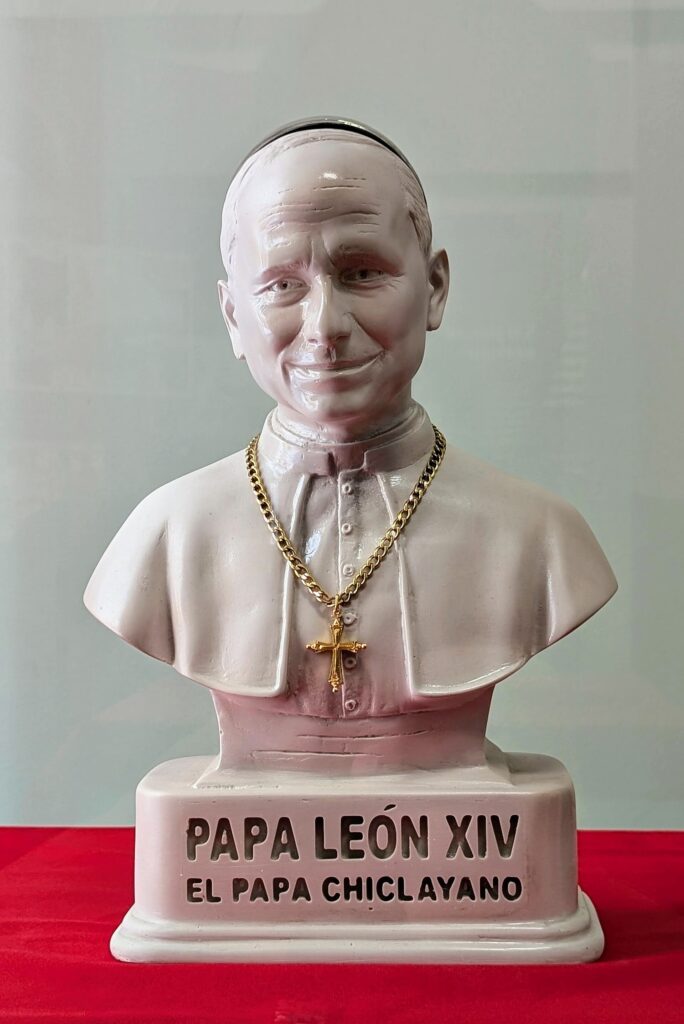
Photo: H.dav.are / Wikimedia Commons (CC BY-SA 4.0)
Pope Leo XIV returned Friday to Chiclayo, the Peruvian diocese he served as bishop before his election, in a homecoming that placed the poor at the centre of his message. He celebrated Mass at Pampas de Pimentel before some 500,000 people, according to the Holy See’s bulletin, and used the day’s engagements to return repeatedly to the needs of the excluded.
The visit on November 13 formed part of the pope’s November 6-17 apostolic journey to Uruguay, Argentina and Peru. It began with a balcony greeting in Lima, before Leo travelled to Chiclayo for a programme that combined large public gatherings with smaller, more personal encounters.
His programme also included a private chapel visit, a meeting with the faithful at the Shrine of Our Lady of Peace, an address to the community at Santo Toribio de Mogrovejo Catholic University and supper with priests at the close of the day.
For a pope returning to a diocese where he had once served as bishop, the schedule carried the character of a return home. The emphasis of the day, however, was not on nostalgia. It was on the people he had come to meet and the responsibilities he said the Church owed them.
The Library Media reported Thursday that Leo had placed “the least among us” at the centre of his public message on his first full day in Peru. In Chiclayo, he returned to that theme with a direct appeal to serve those on the margins.
‘Serve especially the poor and excluded’
At the Shrine of Our Lady of Peace, Leo told those gathered to “serve especially the poor and excluded.” He presented care for vulnerable people not as an optional part of Christian life, but as a central requirement of the Church’s work.
He also described attention to the realities facing vulnerable communities as a central obligation of the Church. He said:
“Listening to social and cultural realities… accompanying families, young people, migrants, indigenous peoples, people in situations of poverty… are not optional tasks; they are demands of our ecclesial mission.”
The words linked the Church’s mission to communities and individuals facing a range of pressures, from migration and family life to poverty and exclusion. The message was directed to the faithful gathered at the shrine and to the wider Church, and it placed service to the poor within the Church’s core purpose rather than at its edges.
The emphasis echoed his earlier statements in Lima, where his first full day in Peru had centred on the least among those present. In Chiclayo, that message was repeated in a place where Leo had once served as bishop, giving it the character of a return to a familiar community as well as a restatement of a central theme.
‘A warning about progress without justice’
At Santo Toribio de Mogrovejo Catholic University, Leo broadened the argument beyond the Church’s immediate pastoral work to questions of economic and technological change.
“A progress that is indifferent to justice and the dignity of workers becomes… a mechanism of oppression and exclusion.”
He also warned that “technology without a soul does not truly improve life.”
The pope’s address connected questions of progress with the distribution of its benefits. He warned against a form of development that leaves the poor behind while concentrating advantage among the few. In that context, he said progress must not become “a privilege reserved for millionaires seeking immortality, while entire peoples suffer from poverty and oppression.”
Leo also referred to St. Turibius and his defence of Indigenous peoples subjected to exploitation and discrimination. The reference connected the university’s namesake and the history of the Church in Peru with the pope’s present concern for communities facing exclusion.
His message was not an argument against progress itself, but against progress detached from justice and human dignity. He also named “the new forms of moral and civic illiteracy that exclude the poor” as a challenge for education and public life.
The pope urged those listening to turn their convictions into practical action, calling on them to “translate it into works of social justice, especially for the benefit of the poorest.”
The address placed workers, Indigenous peoples and communities living in poverty within a wider discussion about the purpose of development. It presented justice not as an addition to progress, but as a measure of whether progress was genuine.
‘A return to a familiar place’
Friday’s visit carried particular significance because Chiclayo was not simply another stop on the pope’s itinerary. It was the diocese where he had served as bishop before his election, and the day’s events unfolded in a place he knew.
The Holy See’s programme combined major public events with meetings in more intimate settings, from the large Mass at Pampas de Pimentel to the chapel visit and the supper with priests. The contrast between the scale of the Mass and the smaller gatherings underlined both the public and personal dimensions of the return.
The scale of the Mass demonstrated the public significance of his return. Some 500,000 people attended, according to the Holy See’s bulletin, in an event that brought together large numbers of the faithful in a single place.
Yet the central thread of the pope’s words remained directed towards those who may have the least power in society. The repeated references to the poor, the excluded and Indigenous peoples gave the homecoming a clear moral focus.
The apostolic journey continues in Peru with visits to Cusco and Pucallpa, followed by further engagements in Lima and Callao, before Leo returns to Rome on November 17.
For Chiclayo, Friday was a return home for a former bishop. For the pope, it was also another opportunity to place the poor at the centre of his message — and to make clear that, in his view, they belong there.
Maya Wilson
World Desk Lead, The Library Media
From The Library — the estate of our family.


