
The Library Media — National & World · World Desk
From the Andes to Zaña, Pope Leo XIV Calls Peru to Remember the Poor and the Forgotten
By Maya Wilson
Photo: GORE Callao / Wikimedia Commons (Public domain)
Pope Leo XIV returned to the cathedral where he began his episcopal ministry in Chiclayo on Saturday morning, then travelled by helicopter into Peru's Andes before ending the day at the shrine of Saint Turibius of Mogrovejo in Zaña. Across the day's services and addresses, he returned to themes of insecurity, economic hardship, migration and the dignity of communities whose suffering, he said, must not become something others simply accept.
The day began at 7:55 a.m. local time, when Leo walked from the Bishop's residence in Chiclayo to the Cathedral of Saint Mary for the Rite of Coronation of the Immaculate Virgin. In his homily, he recalled the personal significance of the setting: "in the same cathedral in which I began my episcopal ministry in the service of this Diocese of Chiclayo."
Leo, who served as Bishop of Chiclayo from 2015 to 2023, also spoke about the insecurity and suffering affecting communities. "We feel threatened by the uncertainty of widespread violence and by the unspeakable suffering that continues to afflict so many of our brothers and sisters," he said.
From the cathedral, the Pope travelled by car to the Teniente Coronel Pedro Ruiz Gallo – Grupo Aéreo No. 6 Air Base. His helicopter departed at 9:20 a.m. and arrived at 10:07 a.m. in Santa Cruz de Succhabamba, in the Department of Cajamarca in the Peruvian Andes.
Before celebrating Mass, Leo stopped at the Parish of Our Lady Immaculate. He prayed silently before the image of the Señor del Costado, paid a floral tribute, greeted the faithful and spent time with some people with disabilities, according to the Holy See's account of the day's programme.
In the Andes, a call for patience and dignified work
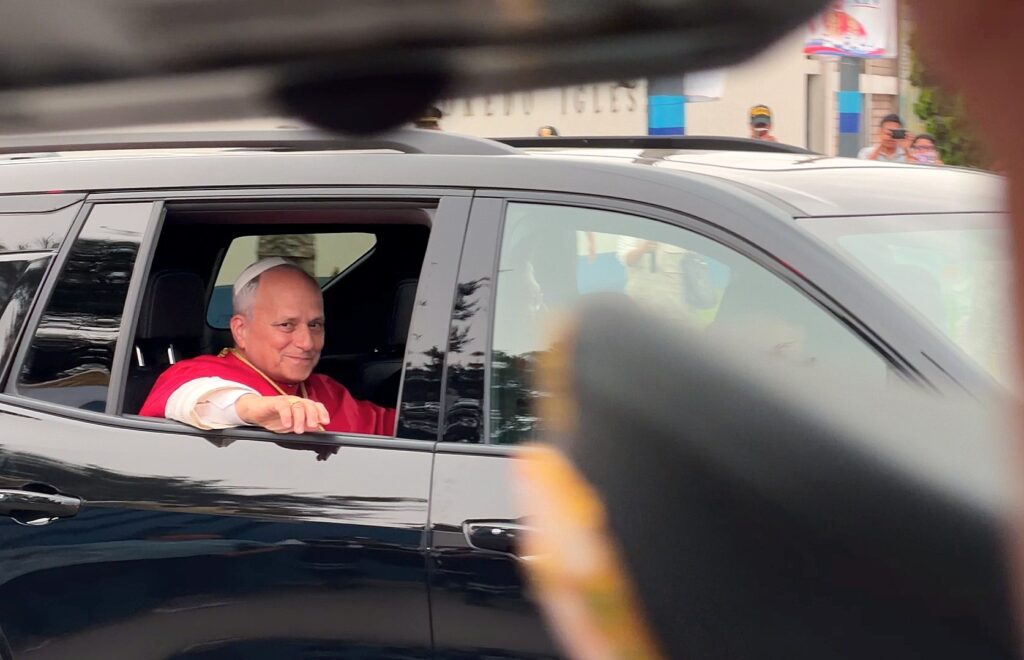
The Mass on the esplanade of Santa Cruz de Succhabamba began at 11:06 a.m. More than 20,000 faithful awaited the Pope, according to the Holy See bulletin. Leo travelled among the gathered people in an open car before the service. At its conclusion, Bishop Edinson Egdardo Farfán Córdova of Chiclayo delivered words of gratitude.
In his homily, based on the Gospel passage of Luke 18:1-8 and the parable of the persistent widow, Leo focused on the vulnerability of people facing social and economic disadvantage. He described the widow as "a symbol of social disadvantage and dependence in the cultural context of that time."
He connected that vulnerability with pressures facing communities in the Andes and elsewhere in Peru, including migration, demographic change and the distribution of resources.
"Let us think, for example, of the suffering of those who are forced to leave their homeland in search of a better future for themselves and their families in the great coastal cities; of the difficulties surrounding generational succession due to the declining birth rates that are emptying villages; and of the challenge of equitably distributing the land's resources."
The Pope urged perseverance in confronting injustice, rejecting brutality as a response to wrongdoing. He said "selfishness, injustice and evil are not overcome by brutality, but by prayer, patience and perseverance in denouncing what is wrong."
He also praised people working to create employment and sustain local communities, naming farmers, shopkeepers and small business owners. "I wish to commend those who, with ingenuity and an entrepreneurial spirit, strive to provide people with dignified jobs: farmers, shopkeepers, small business owners and so many others who, here day after day, put their God-given talents at the service of their communities."
Leo paid tribute to the missionaries and catechists who had carried the Christian faith into remote Andean communities over five centuries, often without priests. At the close of his remarks, he added an impromptu expression of confidence in the faith of the people gathered there: "I know that if Jesus decides to come to Santa Cruz, he will find faith."
The Pope departed by helicopter at 12:50 p.m. and landed back in Chiclayo at 1:30 p.m., according to the Holy See programme.
Zaña and the memory of the forgotten
At 4:30 p.m., Leo travelled to the Shrine of Saint Turibius of Mogrovejo in Zaña for a prayer meeting marking the close of the Jubilee Year of Saint Turibius, commemorating the third centenary of the saint's canonization. Turibius died in Zaña during a pastoral visit.
The Pope received the keys to the city and walked to the chapel accompanied by a traditional dance before praying at the saint's tomb. Approximately 10,000 faithful took part at the shrine, while more than 300,000 people awaited him along the route to Zaña, according to the Holy See bulletin.
Before Leo addressed the gathering, testimonies were given by a priest, a missionary and a representative of the Afro-descendant community.
His address drew on his own connection to the town. He recalled spending the night before the beginning of his episcopal ministry in Chiclayo in prayer at Zaña, asking through Saint Turibius's intercession for the grace to become a pastor according to God's heart.
He also addressed the history of the Afro-descendant community, recalling the suffering of people brought far from their homes and subjected to slavery. "Zaña also preserves the memory of generations of African men and women, far from their homes and subjected to slavery. Many suffered great hardship and humiliation."
Turning directly to the community, he said: "Dear Afro-descendant brothers and sisters: I want to express my affection and closeness to you today."
Leo then spoke about the insecurity and discrimination affecting families in the area. "I know that many families in this land suffer because of crime, extortion, and insecurity. It pains me to think of those who live in fear, those whose honest work is threatened, and those who still suffer discrimination. I keep them in my prayers and ask the Lord to grant them the peace they so desperately need."
His closing appeal was for solidarity and attention to the hardship of others: "I urge you to remain united, to care for one another, and never to become accustomed to the suffering of others."
The Saturday programme placed the Pope's former diocese, the remote Andean communities and Zaña's historical memory within a single day's journey. His apostolic visit to Uruguay, Argentina and Peru continues through November 17. On Sunday, November 15, he is scheduled to visit Cusco and Pucallpa, followed on Monday by engagements in Lima and Callao. He is due to return to Rome on November 17.
Maya Wilson
World Desk, The Library Media
From The Library — the estate of our family.
Follow Us


