
The Library Media — National & World · World Desk
Hundreds of Thousands Rally in Prague Against Scrapping the Licence Fee That Funds Czech Public Media
By Maya Wilson
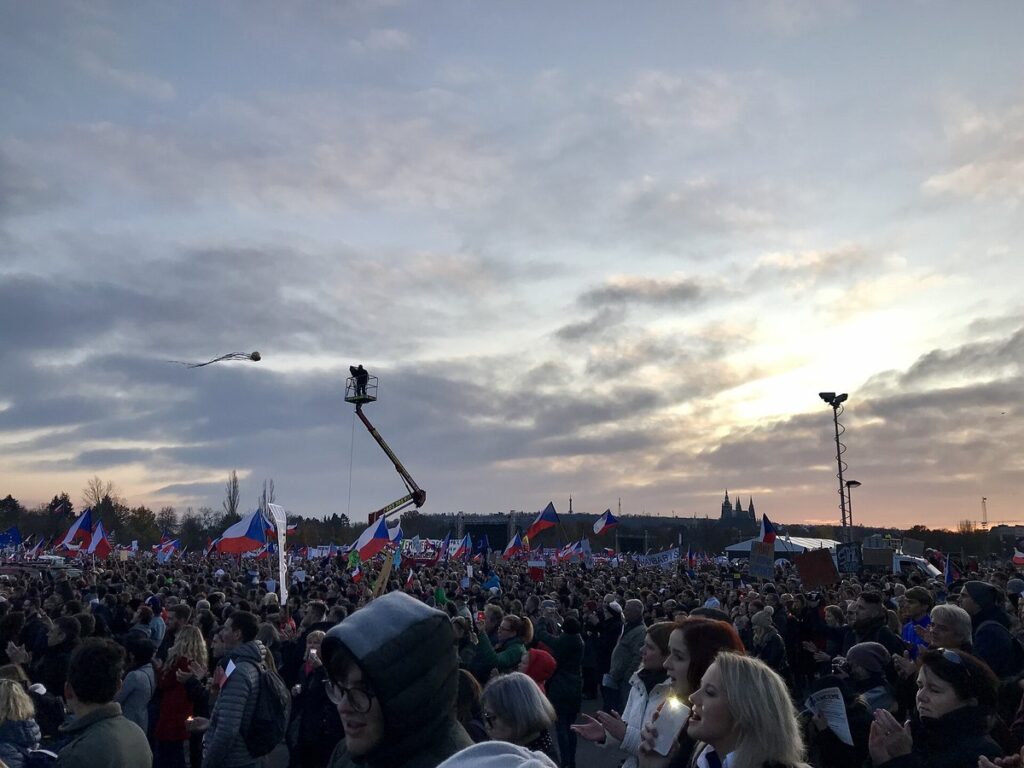
Photo: Martin2035 / Wikimedia Commons (CC BY 4.0)
Hundreds of thousands of people gathered on Prague’s Letná Plain on Sunday in one of the largest demonstrations in the Czech Republic’s modern history, protesting against the government’s plan to abolish the licence fee that funds Czech Television and Czech Radio and replace it with direct funding from the state budget.
Organisers, the pro-democracy group Million Moments for Democracy, said more than 350,000 people took part, according to The Guardian, describing the rally as “one of the biggest in the country’s history.” The BBC reported a separate organiser estimate of roughly 400,000. No independent crowd count appears in either report, and both figures should therefore be treated as organiser claims rather than settled counts.
The protest was directed at a proposal that would end the system under which households pay 205 crowns a month — about £7, or $9.44 — for public television and radio. Under the government’s plan, Czech Television and Czech Radio would instead be financed from the state budget. Critics argue that the change would give ministers direct leverage over newsrooms whose independence depends on a funding model insulated from political control.
Parliament passed the first draft of the legislation late last month. The Guardian reported that the first reading was pushed through “in the middle of the night” in late October. Protests and a staff strike at Czech Television and Czech Radio have followed, reflecting opposition both on the streets and inside the broadcasters themselves.
Reuters, cited in both articles, estimates that the change would amount to a cut of about 15% in the budgets of Czech Television and Czech Radio. The figure underscores why the funding question has become central to the dispute: supporters of the current system say a substantial reduction, combined with a change in the source of funding, would weaken the broadcasters’ ability to operate independently.
The government is led by Prime Minister Andrej Babiš, a billionaire who returned to power last year and was appointed in December 2025. He leads a coalition of ANO, the Motorists for Themselves, and Freedom and Direct Democracy. Babiš has rejected suggestions that the government intends to control public media.
“No one wants to control, dictate to, or nationalise public media,” he said. “Under no circumstances will we interfere in editorial work.”
He has called the criticism unfounded and argued that the direction of travel in Europe supports the change. France removed its licence fee in 2022, and Norway did so in 2020, examples cited by the government as evidence that most of Europe is moving the same way. His coalition insists the change will not affect editorial independence, while also arguing that the broadcasters should cut costs.
ANO still polls at about 30%, a level that has allowed Babiš to present the government as acting with a strong mandate, even as the scale of Sunday’s demonstration suggested substantial public opposition to this particular measure.
The proposal has drawn criticism beyond the Czech Republic. The European Broadcasting Union, the European Federation of Journalists, Reporters Without Borders and the International Press Institute have all criticised the plan. Critics have likened it to moves in Slovakia under Robert Fico and Hungary under Viktor Orbán, where governments have been accused of using funding and regulatory pressure to weaken independent media.
Mikuláš Minář, the lead organiser for Million Moments for Democracy, told protesters that the demonstration was only the start of the campaign. “It’s just a beginning,” he said. The group has demanded that the government withdraw the plan altogether, rather than amend it.
Many protesters wore paper hats honouring Večerníček, the long-running host figure of Czech Television’s children’s bedtime stories. The image gave the rally a distinctive visual character, linking the defence of public media to a shared cultural reference familiar across generations.
The dispute now turns on whether funding from the state budget can be reconciled with editorial independence. The government says it can, pointing to other European countries and promising not to interfere. Its critics, including journalists’ organisations and the hundreds of thousands who gathered on Letná Plain, argue that the source of the money matters as much as the amount — and that a broadcaster dependent on annual decisions by ministers is more vulnerable than one funded by a licence fee paid directly by households.
Maya Wilson
World Desk Lead, The Library Media
From The Library — the estate of our family.
Follow Us


