
The Library Media — National & World · National Desk
A Brand-New AI System Went Nationwide This Week — Then the FAA’s Radios Failed
By Catalina Clarke
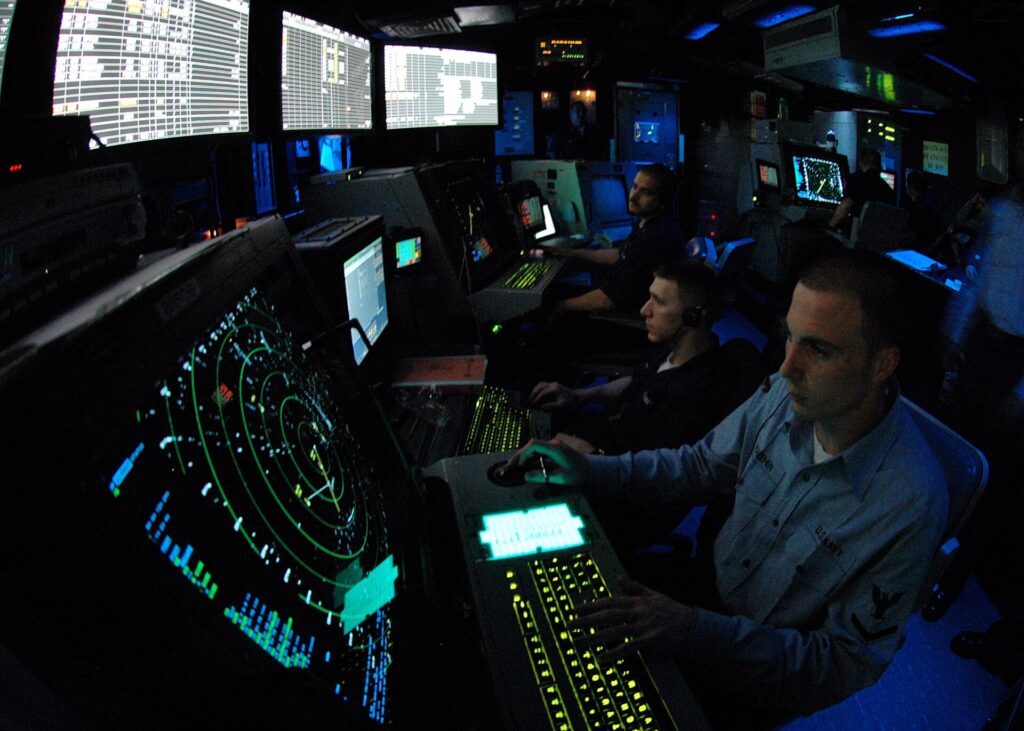
Photo: U.S. Navy photo by Photographer’s Mate Airman Ronald A. Dallatorre / Wikimedia Commons (Public domain)
Three days before the Federal Aviation Administration grounded every departing flight in America, the agency finished switching on the biggest change to its systems in years: an $875 million artificial intelligence platform, active in all 22 of the control centers whose communications failed on Friday.
The system is called SMART — Strategic Management of Airspace, Routes and Trajectories. The FAA introduced it in the Washington, D.C. area on September 21 and announced on November 10 that it was extending it to the airspace of all 22 Air Route Traffic Control Centers. Built with the analytics firm Air Space Intelligence, SMART draws on some 200 data streams — weather, flight paths, traffic flow, controller staffing — and recommends routes and schedules to controllers, who keep the final say. The agency credits it with rerouting 180 flights in its first weeks, saving an average of 10 minutes and nearly 80 gallons of fuel per flight. The National Air Traffic Controllers Association, the union whose members use it, says it was not consulted or involved in the system’s design, testing, or implementation.
What SMART is not
On the public record, SMART does not carry the radios. It is an advisory layer for routing decisions. What failed on Friday, by the Transportation Department’s own account, was communication — Secretary Sean Duffy cited a communication issue affecting all Air Route Traffic Control Centers, and FAA sources have described a rolling frequency outage at the facilities that monitor aircraft in flight. No official has linked SMART to the failure, and no official has established any cause at all. When a reporter put the AI question to Homeland Security Secretary Markwayne Mullin on Friday, he said investigators cannot rule out anything at this point — and joked, “We call it SI, remember.”
The network that failed, and the man who spent a year attacking it
The voice network at the center of the outage is operated under the FAA’s telecommunications infrastructure program by L3Harris. It is also the network Elon Musk spent much of 2025 attacking while his company angled for the FAA’s communications business. Musk declared the air traffic system was breaking down and accused Verizon of putting travelers at serious risk — then admitted the accusation was false: the system in question is run by L3Harris, not Verizon. Verizon holds a separate contract, awarded in 2023 and worth up to $2.4 billion over 15 years, to modernize the FAA’s communications platform; the Washington Post reported the agency was close to canceling it in favor of Musk’s Starlink, which the FAA had begun testing at facilities in New Jersey and Alaska. SpaceX denied any takeover, a team of its engineers worked inside the FAA during the DOGE period, and Senator Ed Markey urged that Musk and the FAA’s acting chief be called to testify about the arrangement and its conflicts of interest.
None of that establishes any connection to Friday’s failure. Starlink’s FAA role, on the record, was testing at a handful of sites. What it establishes is that the communications system which failed in front of the whole country has been a contested prize — criticized by the man whose satellites were positioned to replace pieces of it, defended by its operator, and funded through a contract whose future has been in doubt for over a year.
The questions that now need answers
What exactly failed on Friday — which system, which component, whose equipment? When did SMART’s activation complete at each center, and did anything in the centers’ systems change this week? Does any part of the new platform touch the frequency network that went down? And who investigates — the FAA examining its own rollout, or an outside body? The Justice Department has assessed that the failure is not a national security matter, and Secretary Mullin says there is no indication of an attack. A technical failure, then — in the week the government’s newest system went nationwide, inside a network a billionaire spent a year calling broken. The public that sat in those terminals is owed the specifics. So far, it has been given almost none.
Catalina Clarke
National Desk, The Library Media
Update — Friday night: At the White House briefing Friday night, Transportation Secretary Sean Duffy ruled out any role for SMART: “There was no possible way SMART would have impacted what happened today.” Air Space Intelligence said the same in its own statement: “The current ground stop is not based on or a result of the SMART system, or any product of ASI or our integration with FAA and ATC.” Duffy attributed the failure to aging switches and routers overloaded with data, and no evidence has emerged connecting SMART, ASI, or any AI system to the outage.
From The Library — the estate of our family.


